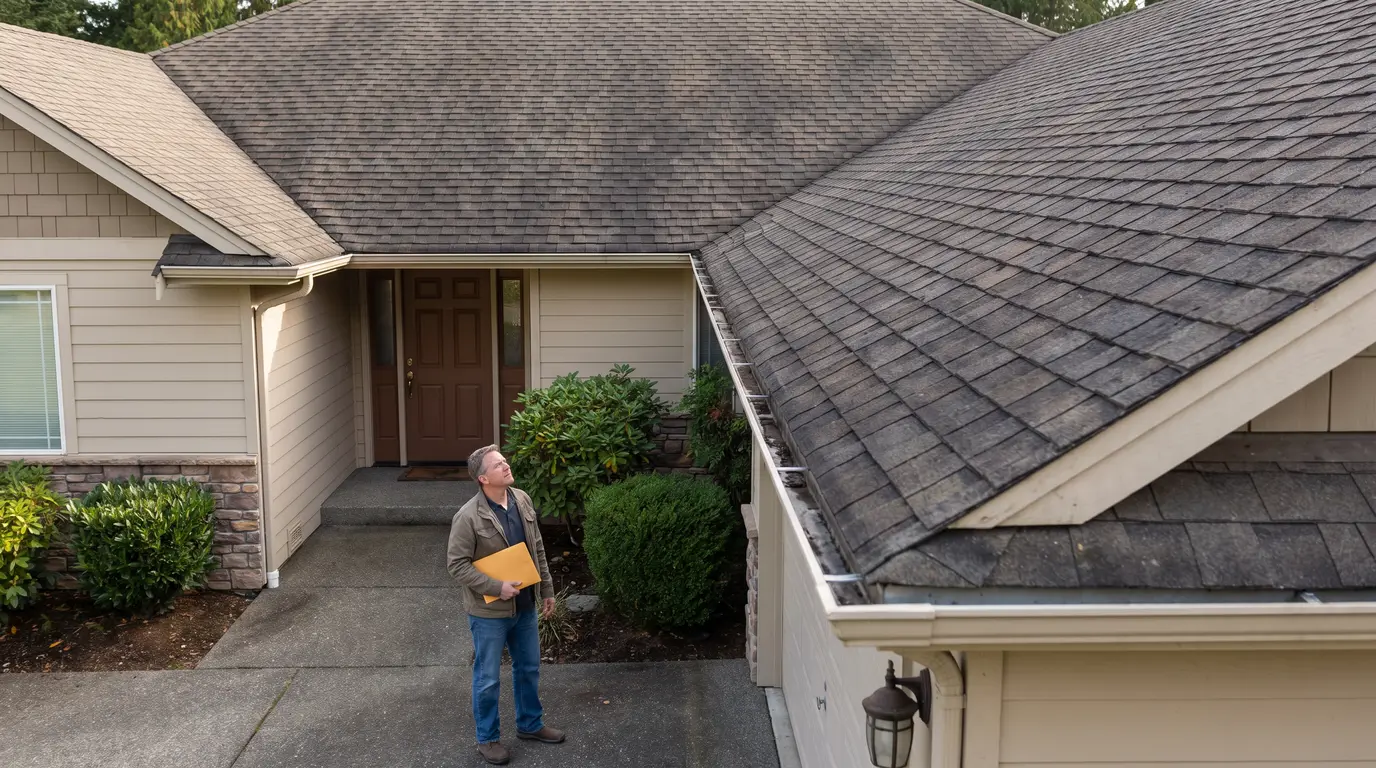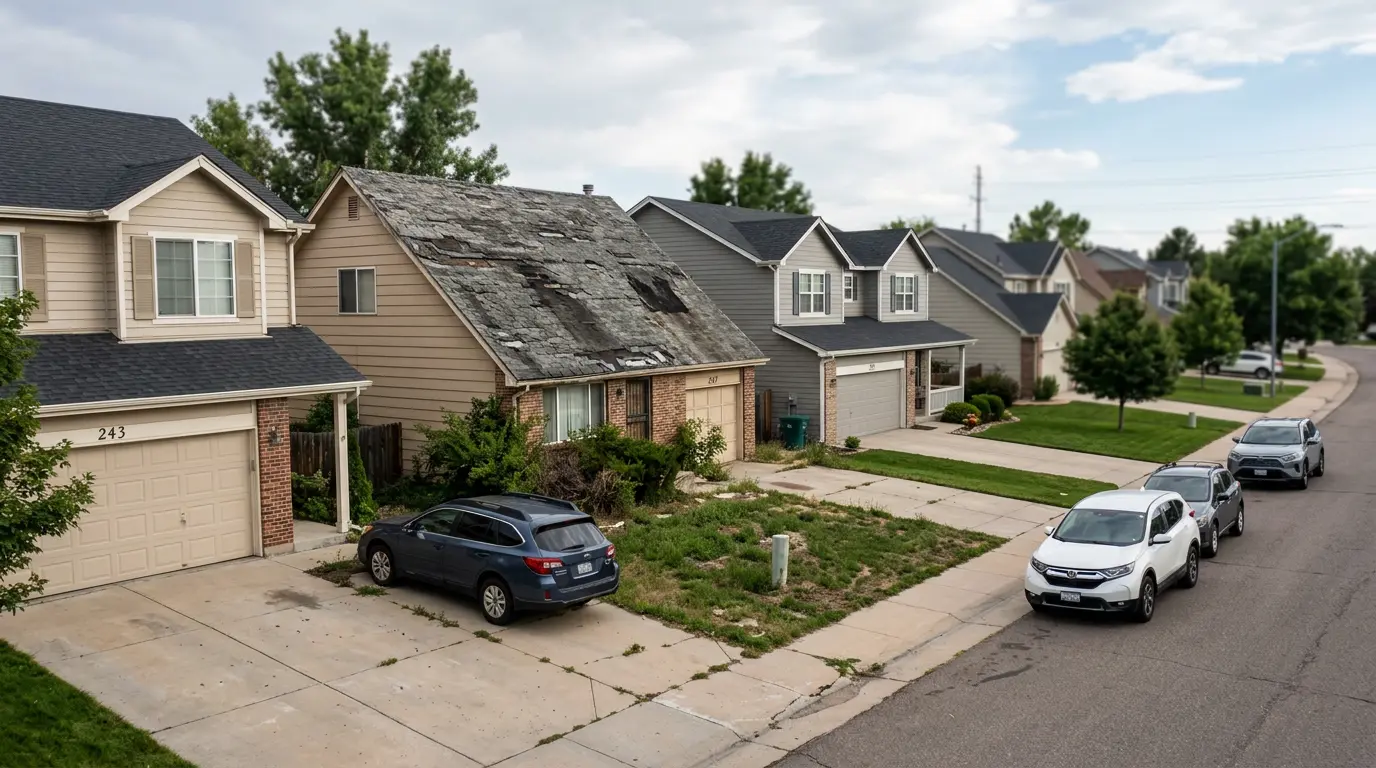
Yes, an HOA may be able to require a homeowner to repair or replace a roof, but there is no universal nationwide rule. The answer usually depends on the recorded governing documents, the roof’s legal classification, applicable state law, the roof’s actual condition, and whether the HOA followed the required enforcement procedure.
Two questions should be answered before anyone hires a contractor or starts arguing about shingles. First, who is responsible for maintaining, repairing, and replacing the roof? Second, what authority does the HOA have to enforce that responsibility?
A demand based on an assigned maintenance duty, structural problem, safety concern, code condition, or valid appearance standard is different from a board simply deciding that an older roof would look nicer if it were new. Condominium roofs, townhouse roofs, individual unit roofs, and limited or exclusive use common areas may all be governed differently.
When Can an HOA Require a Homeowner to Replace a Roof?
An HOA may have authority to require roof work when the governing documents assign that duty to the homeowner and applicable law allows the association to enforce it. The relevant documents may include the declaration or CC&Rs, bylaws, architectural rules, maintenance provisions, and policies concerning exterior features or damage.
Look for language addressing owner maintenance, repair, and replacement duties; roof or exterior maintenance; architectural control; damage caused by an owner, tenant, or guest; enforcement remedies; self help; and recovery of repair costs. The exact wording matters. A general promise to maintain a property may not answer the separate question of who must replace a roof serving several homes.
A replacement demand is more likely to have a valid basis when the documents require the owner to keep the roof in a stated condition, correct damage, address a safety issue, comply with a uniform appearance rule, or meet an applicable code requirement. That does not mean the HOA can automatically demand a complete replacement whenever a roof looks old. Age or appearance alone may not establish replacement authority.
Architectural control can also matter, but it does not solve every roof dispute. An HOA may regulate roofing materials, color, appearance, or alterations without having authority to make the owner pay for a full replacement. A board issued demand is not automatically enforceable simply because it arrived on official letterhead. The document authority, facts, procedure, and available remedy all matter.
For background on how state law can allocate roof responsibilities, see California Civil Code Section 4775 and Florida Statutes Section 718.113. These are jurisdiction specific examples, not a national HOA rule.
First Determine Who Is Responsible for the Roof
The person who lives under a roof is not necessarily the person who must replace it. A roof may be part of an individual lot or unit, a shared townhouse structure, a common element maintained by the association, or a limited or exclusive use common area with responsibilities divided between the owner and the HOA.
Ownership, maintenance, repair, and replacement are separate concepts. Governing documents and state law may assign those duties to different parties. That distinction is especially important in condominiums, where a roof can serve multiple units and may be treated as a common element even though an individual owner has physical access to the space below it.
If the roof is a common element, the association may be responsible for arranging and funding the work. In that situation, the HOA may not be entitled to order the individual owner to independently contract for replacement. The owner may still have obligations involving access, an allocated assessment, or damage caused by the owner, tenant, guest, or an unauthorized alteration.
California provides one jurisdiction specific example. Under the statutory default described in California Civil Code Section 4775, the association generally handles repair, replacement, and maintenance of common areas unless the declaration provides otherwise. For an exclusive use common area, the owner generally handles maintenance while the association generally handles repair and replacement, again subject to the declaration.
Florida condominium law similarly places common element maintenance, repair, and replacement with the association except where the declaration assigns limited common element maintenance differently. Neither example should be treated as a universal rule for every community or property type.
To classify the roof, compare the declaration with the recorded plat, condominium plan, unit boundaries, and the roof’s physical configuration. A maintenance chart or exterior maintenance policy may provide useful guidance, but it should be read together with the recorded documents rather than treated as a substitute for them.
Roof Replacement Authority Is Different From Architectural Control
An HOA may have authority to control what a roof looks like without having authority to force a complete replacement. Architectural rules may address roofing materials, color, appearance, alterations, or approval before work begins. Those rules answer what an owner may install or change. They do not necessarily answer who must perform or pay for a replacement caused by deterioration.
This distinction also applies when an owner voluntarily replaces a roof, changes materials, or installs solar equipment. Architectural approval may be required for the proposed change even when the owner is responsible for ordinary roof maintenance. Approval authority and financial responsibility are separate questions.
Building code operates on a separate track. A locally adopted code may address roofing materials, installation methods, permits, or replacement after damage. An HOA rule cannot waive a mandatory code requirement, but code compliance does not automatically determine whether the homeowner or the association must pay. The private allocation of responsibility still depends on the governing documents and applicable state law.
Local code and permit requirements must be verified for the property. The fact that a roof meets code does not by itself defeat an otherwise valid HOA maintenance obligation, and the fact that an HOA wants a particular appearance does not by itself create authority to charge the owner for full replacement.
What Enforcement Tools and Procedures May Apply?
Depending on the state, governing documents, and facts, an HOA may use a written violation notice, a cure opportunity, a hearing, a fine, suspension of certain privileges, an authorized charge for repair costs, self help, mediation, arbitration, or a court action. Not every HOA has every remedy, and a remedy listed in a declaration may still be subject to statutory limits and procedural requirements.
A court action seeking specific performance is one possible route. Specific performance means asking a court to order the owner to perform a stated obligation, such as correcting a condition assigned to the owner. It is not the automatic result of a violation notice.
Texas illustrates why jurisdiction matters. Guidance from the Texas State Law Library describes litigation, specific performance, fines, and self help as possible enforcement tools when authorized. It also discusses civil damages of up to $200 per day under Texas Property Code Section 202.004. That is a Texas specific example, not a nationwide penalty or an automatic consequence of refusing a roof demand.
Notice and hearing rules can affect whether a fine or charge is valid. In California, Civil Code Section 5855 requires written notice at least 10 days before a board meeting considering discipline or a monetary charge for damage to common area facilities, followed by written notice of the decision within 14 days after the action. In Florida, Section 720.305 provides a hearing procedure before a fine or suspension is imposed.
Those timelines apply in their identified jurisdictions and contexts. They do not establish a national notice period. A roof obligation and a charge for owner caused damage may also involve different provisions, particularly where the HOA must establish causation and follow a required process.
A dangerous, leaking, structurally deficient, or code noncompliant roof may justify faster action. Even then, the association’s authority depends on the declaration, applicable law, emergency powers, code requirements, and the facts. “Emergency” is not a magic word that erases every procedural requirement.
Who Pays for the Replacement?
Responsibility for performing the work and responsibility for funding it are related, but they are not the same question. Start with the roof’s classification and the declaration’s allocation of maintenance, repair, and replacement duties.
An association responsible for a common element may use reserves, assessments, insurance, or another legally authorized funding source to arrange replacement. Reserve funding or a special assessment may help pay for association work, but the existence of a reserve or assessment power does not establish that an individual owner must replace a roof assigned to the association.
An owner may still face an allocated assessment even when the HOA contracts for the work. A separate charge may also be possible for damage caused by the owner, tenant, guest, unauthorized alteration, or failure to perform a maintenance duty, but only when the governing documents or applicable law authorize that charge and the required facts and procedures are established.
Florida condominium law identifies roof replacement among capital expenditures and deferred maintenance items relevant to reserve budgeting. That Florida condominium context can help explain how association funded work may be planned, but it does not create a universal reserve requirement or transfer responsibility for every roof to an individual homeowner.
What to Do If the HOA Demands Roof Replacement
Do not ignore the notice, but do not assume the demand is correct simply because it came from the board. A document focused response can clarify whether the dispute concerns responsibility, roof condition, appearance, cost, procedure, or several of those issues at once.
Gather the Governing Documents
Obtain the recorded declaration or CC&Rs, amendments, bylaws, rules, maintenance chart, architectural standards, and any roof or exterior maintenance policy. Search for terms such as “roof,” “maintenance,” “repair,” “replacement,” “common element,” “limited common element,” “exclusive use,” “owner responsibility,” “damage,” “architectural control,” and “self help.”
Ask the HOA to Identify Its Authority
Ask in writing for the exact covenant, rule, statute, inspection finding, code provision, and enforcement authority supporting the demand. Also ask whether the HOA is requiring a repair, a full replacement, a uniform appearance, insurance compliance, or correction of a safety or code condition.
Check the Procedure and Deadlines
Review the violation notice, cure deadline, hearing opportunity, fine schedule, appeal or internal dispute process, mediation or arbitration clause, and any required board vote. These details may affect what the HOA can do next and what response options are available to the owner.
Obtain an Independent Roof Assessment
A written assessment from a qualified roofing professional or engineer can help separate cosmetic wear from repairable damage, active leakage, structural problems, remaining service life, and conditions that may indicate full replacement. An independent opinion does not automatically invalidate the HOA demand, because the documents, law, roof classification, and enforcement procedure still matter.
Preserve the Record
Keep dated photographs, inspection reports, contractor proposals, correspondence, meeting minutes, notices, governing document versions, permits, and records of prior maintenance. Those materials may become important if the dispute concerns the roof’s condition, responsibility, notice, authorization, or causation.
Before withholding assessments, refusing access, hiring a contractor, or allowing the HOA to enter and perform work, obtain advice from a lawyer licensed in the property’s state. The consequences involving noncompliance, liens, self help, and emergency access are jurisdiction specific.
Common Misconceptions About HOA Roof Demands
Misconception: An HOA can require any homeowner to replace a roof whenever the board thinks it looks old.
Correction: The HOA needs authority in the governing documents or applicable law, a valid basis for the demand, and compliance with required procedures. Age or appearance alone may not be enough.
Misconception: The person who owns the roof always must replace it.
Correction: Ownership, maintenance, repair, and replacement duties may be allocated differently, especially for condominium roofs and limited or exclusive use common areas.
Misconception: If the HOA controls roof color or materials, it automatically pays for replacement.
Correction: Architectural control and financial responsibility are separate issues. Approval authority does not automatically assign the cost of full replacement to either party.
Misconception: A violation notice proves the HOA can immediately replace the roof and charge the owner.
Correction: The declaration, applicable law, authorization for cost recovery, supporting facts, and notice and hearing procedures all matter. A notice is an important document, but it is not by itself proof that every proposed remedy is available.
Misconception: Building code determines who pays.
Correction: Code establishes public construction and safety requirements. Governing documents and applicable state law generally address the private allocation of responsibility and cost.
Frequently Asked Questions
Can an HOA require replacement instead of allowing a repair or patch?
It may be able to do so when the governing documents and applicable law support a replacement duty, or when the roof’s condition involves a safety, structural, code, or other valid maintenance concern. An independent roofer’s view that a repair is possible is useful evidence, but it does not alone resolve the legal question.
Is a townhouse roof usually the homeowner’s responsibility or the HOA’s responsibility?
There is no universal answer. A townhouse roof may be assigned to an individual lot owner, treated as a common element, or governed through a divided arrangement. The declaration, recorded plat, physical roof configuration, and applicable state law must be reviewed together.
Who pays when a condominium roof is a common element?
The association may be responsible for arranging the replacement and funding it through reserves, assessments, insurance, or another authorized source. Owners may still pay an allocated assessment or a properly authorized charge, depending on the declaration, law, and facts.
Can an HOA fine or place a lien on a homeowner for refusing roof work?
That depends on the governing documents, applicable state law, the type of charge, and required procedures. Fines, liens, self help, and cost assessments are not automatically available to every HOA. State specific rules may require notice, a hearing, authorization, or proof of damage.
What notice and hearing rights may apply to an HOA roof replacement violation?
Requirements vary by state and by the action being considered. For example, California has a specific notice procedure for discipline or a monetary charge for damage to common area facilities, while Florida provides a hearing procedure before a fine or suspension. Those rules do not establish a national timeline.
Can an HOA hire a contractor to replace the roof without the owner’s consent?
Possibly, but only if the association has authority under the governing documents and applicable law, and follows any required procedure. If the roof is a common element, the HOA may be the proper party to arrange the work. If it is owner responsibility, self help and access rights still depend on the specific documents, law, emergency circumstances, and facts.
What should an owner do if the HOA demands replacement but an independent roofer says repair is sufficient?
Obtain the assessment in writing, preserve photographs and other records, and ask the HOA to identify the exact authority and condition supporting the demand. Check the response deadlines and dispute procedures, then obtain advice from a lawyer licensed in the property’s state before refusing access, withholding assessments, or authorizing competing work.
The Practical Takeaway
An HOA may be able to force roof repair or replacement, but only when the governing documents, roof classification, applicable state law, roof condition, and enforcement procedure support that result. The most important first step is to determine whether the roof belongs in the owner responsibility column, the association responsibility column, or a divided category.
Read the governing documents, request the HOA’s written basis, obtain a documented roof assessment, and verify local code and permit requirements. Before taking consequential action, get state specific legal advice. Roof disputes are much easier to manage when the shingles are not the only thing being examined.