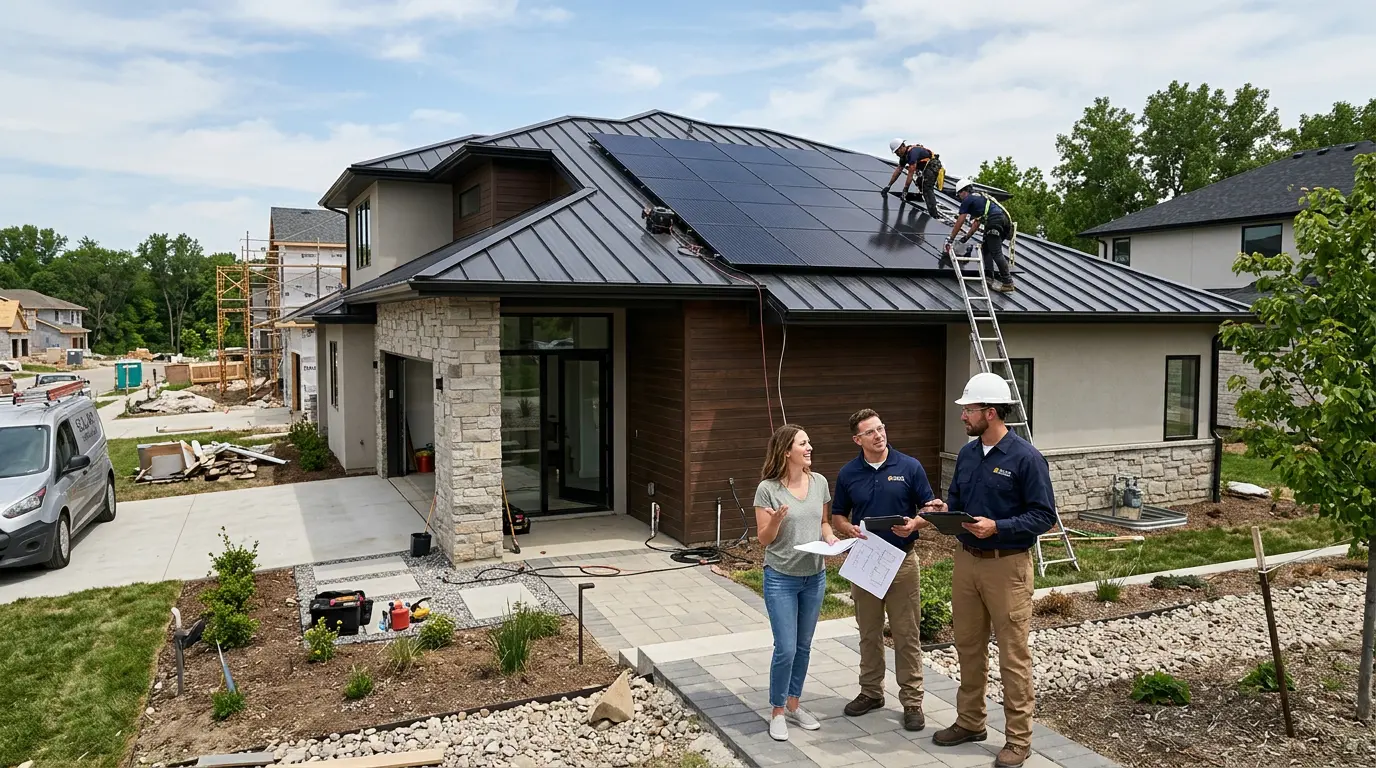
Solar panels installed during or shortly after a new home build could historically qualify for a federal homeowner incentive, but the timing rules were not as simple as the date on a purchase contract. The former Residential Clean Energy Credit generally applied to qualified solar electric property connected to a new or existing home in the United States that the taxpayer used as a residence.
That federal credit was terminated for expenditures after December 31, 2025. A deposit, equipment order, or early payment did not automatically preserve the credit if the applicable construction, original use, or installation event occurred after the deadline. Ownership, residence use, the way solar costs were included in the purchase, and the specific state or utility program also matter.
The Short Federal Answer for New Construction
Under the former federal Section 25D rules, solar electric property could qualify when connected to a new home, not only when added to an existing home. The home had to be located in the United States and used as a residence by the taxpayer. For qualifying expenditures through December 31, 2025, the credit was generally 30 percent.
That is historical eligibility, not a currently available federal credit for new 2026 expenditures. The Residential Clean Energy Credit was not allowed for expenditures made after December 31, 2025. A system completed in 2026, or a newly built home first used in 2026, generally cannot receive a new Section 25D credit merely because the system was ordered, contracted for, or partly paid in 2025.
New construction also had a different timing rule from an ordinary solar retrofit. For ordinary property, costs were generally treated as paid when original installation was completed. For costs connected with constructing or reconstructing a home, the relevant federal event was tied to the taxpayer’s original use of the completed home.
In practical terms, original use means the taxpayer’s first use of the completed constructed or reconstructed home under the applicable federal guidance. It is not simply the date a deposit was paid or equipment was ordered. Closing, possession, installation completion, the certificate of occupancy or equivalent completion event, and moving into the home may all be different dates, and no single date should be assumed to control every program.
For the historical federal rules, you can review the IRS Instructions for Form 5695 and the IRS guidance on the Section 25D changes.
Who Owns the System and Who Paid for It?
Panels on your roof do not automatically make you the person entitled to an incentive. The relevant questions include who purchased the equipment, who owned it at installation and closing, who bore the qualifying cost, and whether the taxpayer uses the home as a residence.
A homeowner owned system, including a system financed as a purchase, is different from a system owned by a solar company. With a lease or power purchase agreement, the third party generally owns the equipment and holds the applicable tax benefits. Paying the electric bill, or living in the home, does not by itself establish ownership of the solar system.
Builder installed systems require careful documentation. If the builder installed panels before closing, do not assume that every solar related amount included in the home contract is a separately claimable homeowner expenditure. The research does not establish one universal answer for every builder installed system. The paperwork needs to show who purchased, owned, and paid for the qualifying property.
- Ask for a reasonable, itemized allocation of the solar equipment and installation costs.
- Confirm who owned the system before closing and who owns it after closing.
- Ask whether the builder, installer, or another system owner claimed a federal benefit.
- Review whether the arrangement was a purchase, a financed purchase, a lease, or a power purchase agreement.
A rental property, investment property, or spec home also requires a different analysis. The former Section 25D homeowner credit depended on the taxpayer using the home as a residence. A builder, landlord, or other owner that does not use the property as a residence should not assume that the homeowner credit applies.
The Department of Energy Homeowner’s Guide to Solar provides general guidance on ownership and third party solar arrangements.
Which New Construction Solar Costs May Qualify?
Under the former Section 25D rules, potentially qualifying costs could include new solar equipment, labor for onsite preparation, assembly, and original installation, along with qualifying wiring or piping that connected the property with the home. Used or previously owned clean energy equipment was not eligible.
New construction often bundles these costs with roofing, framing, electrical work, and other portions of the home. That is where a detailed allocation becomes useful. Traditional roofing or structural components generally did not qualify merely because they supported solar panels. Solar shingles or tiles could be treated differently when they functioned as energy generating property under the applicable rules.
An itemized allocation does not guarantee eligibility. Ownership, payment, timing, residence use, and the requirements of the specific incentive program still have to line up. The total price of the home is not a substitute for documentation showing the amount connected with qualifying solar property.
For a bundled new home contract, request separate amounts for items such as:
- Solar panels and other documented solar equipment.
- The inverter and mounting equipment.
- A battery, if included and separately identified.
- Installation labor and onsite preparation.
- Interconnection wiring or other qualifying connections.
- Traditional roofing, structural work, and other nonqualifying construction costs.
Keep the allocation supported by the builder contract, invoices, settlement documents, payment records, and installation records. The IRS guidance on claiming the Residential Clean Energy Credit explains qualifying installation costs, used property, solar roofing, and recordkeeping.
The Builder’s Section 45L Credit Is a Separate Incentive
Section 45L was a separate federal incentive for an eligible builder or contractor that constructed or substantially reconstructed a qualifying energy efficient new home. It was not a homeowner credit for purchasing solar panels.
For qualifying homes acquired from 2023 through June 30, 2026, the credit could reach $5,000 per home. The amount and eligibility depended on factors such as whether the home was single family or multifamily, the applicable efficiency certification, the Energy Star or Zero Energy Ready Home pathway, prevailing wage conditions, and other requirements. The $5,000 figure was a maximum, not an automatic amount for every new home.
The eligible contractor claimed Section 45L, not automatically the homeowner who purchased the home. Certification also had to be obtained before the home was acquired and before the builder claimed the credit. Under the cited guidance, Section 45L was unavailable for homes acquired after June 30, 2026.
Ask the builder which party is claiming Section 45L and whether the home was certified under the applicable program. A builder’s Section 45L claim does not by itself answer whether a separate homeowner incentive applies. The claimant, costs, ownership, residence use, and timing must be analyzed separately.
See the IRS information on the credit for builders of energy efficient homes and the Instructions for Form 8908.
State, Local, and Utility Incentives Require Separate Verification
Federal eligibility does not establish eligibility for a state rebate, local tax provision, utility incentive, production based program, or renewable energy credit program. These programs differ by location, administrator, funding, ownership rules, and deadline.
A new construction project may need to satisfy conditions involving the installation date, new construction status, utility interconnection, preapproval, a reservation before construction, an approved contractor, system ownership, the customer of record, or builder status. Some programs may also depend on available funding, which means a program found online may not be accepting applications when the project is ready.
Use DSIRE as a starting point, then confirm the current rules with the state agency, utility, or program administrator. Search using the property address and utility account, and ask specifically:
- Is a newly built home eligible for this program?
- Must the application, reservation, or preapproval occur before construction or installation?
- Who must own the system and appear as the utility customer?
- Is interconnection required before the incentive is paid?
- Are approved contractors, builder certifications, or remaining funds required?
The Department of Energy’s Solar Power in Your Community Guidebook describes the range of state, local, utility, and other solar incentive types.
Documents and Questions to Gather Before Claiming an Incentive
Start by identifying the incentive you are evaluating. Keep the former federal Section 25D homeowner credit, the builder focused Section 45L credit, and state, local, and utility programs in separate folders. They may have different claimants, deadlines, and documentation.
Record the dates that could matter to the project. These may include the contract date, payment dates, installation completion date, certificate of occupancy or equivalent completion date, closing date, original move in date, and utility interconnection date. An order date is not automatically the controlling date.
For a bundled home purchase, request the builder’s settlement statement or contract allocation. The supporting documents should distinguish panels, inverter, mounting, installation labor, interconnection wiring, and nonqualifying roofing or structural work where applicable.
Also verify whether the system was purchased, financed as a purchase, leased, or provided through a power purchase agreement. Confirm who owned the equipment at installation and closing, and ask who is entitled to claim each available incentive.
- Contracts and invoices.
- Proof of payment.
- Installation and commissioning records.
- Equipment specifications.
- Permits and interconnection approval.
- Builder allocation documents.
- Applicable certification records.
Retain records sufficient to establish the claimed credit and the property basis. For bundled new construction, a tax professional can help analyze who incurred the qualifying expenditure, how the cost should be allocated, how a rebate affects basis, and whether any 2025 credit carryforward may be available.
Common Misconceptions About New Construction Solar Incentives
Misconception: Paying for solar before December 31, 2025 automatically preserves the federal credit.
Correction: Construction related costs were tied to original use of the completed home, while ordinary installation timing generally followed completion of original installation. Prepayment alone was not sufficient when the applicable event occurred after December 31, 2025.
Misconception: The builder’s Section 45L credit is the same as the homeowner solar credit.
Correction: Section 45L was a separate incentive claimed by an eligible builder or contractor for a qualifying energy efficient home. It was not automatically available to the homeowner who bought the property.
Misconception: Every solar related amount in a new home contract qualifies.
Correction: Solar equipment and certain installation costs needed to be identified and allocated. Traditional roofing and structural components generally did not qualify merely because they supported the panels.
Misconception: The homeowner receives the incentive whenever panels are installed on the roof.
Correction: Ownership, residence use, who incurred the cost, and whether a third party owns the system can change who may claim an incentive.
Misconception: Federal eligibility establishes state or utility eligibility.
Correction: Local programs must be checked separately. Their rules may involve preapproval, interconnection, ownership, customer status, contractor requirements, deadlines, and available funding.
Frequently Asked Questions
Can I claim a solar tax credit if the builder installed the panels before I closed on the home?
It depends on who purchased and owned the system, who bore the qualifying cost, when the relevant construction or installation event occurred, and whether you used the home as a residence. Request an itemized allocation and documentation showing ownership before assuming the cost is your claimable expenditure.
What if I paid for solar in 2025 but the home was completed in 2026?
For the former federal Section 25D credit, payment in 2025 did not automatically preserve eligibility. Construction related timing was tied to original use of the completed home, and the credit was unavailable for expenditures after December 31, 2025.
Does the date I move into a new construction home control federal solar credit eligibility?
For construction related costs under the former federal guidance, the taxpayer’s original use of the completed home was significant. The installation completion date and other project dates may also matter, so move in date should not be treated as a universal rule for every cost or incentive.
Can a builder claim the Section 45L credit while the homeowner claims a solar incentive?
The programs are separate and have different claimant requirements. A builder’s Section 45L claim does not automatically guarantee or prevent a separate homeowner incentive. Ownership, qualifying costs, timing, residence use, and the program rules need to be reviewed separately.
How should solar costs be separated from roofing and other new home construction costs?
Request a supported allocation that separates solar equipment, installation labor, mounting, qualifying interconnection wiring, and other solar related costs from traditional roofing and structural work. Use contracts, invoices, builder documents, and payment records rather than the total home purchase price.
Do leased solar panels or a power purchase agreement qualify for a homeowner incentive?
Generally, the homeowner cannot claim the homeowner credit when a third party owns the system under a lease or power purchase agreement. The system owner may have separate tax treatment, so review the contract and ownership terms.
Are state or utility solar rebates available for newly built homes?
Some may be, but eligibility is location and program specific. Check by property address and utility account, use DSIRE as a starting point, and confirm current requirements, deadlines, preapproval rules, ownership conditions, and funding with the program administrator.
What documents should I request from the builder and solar installer?
Request contracts, invoices, proof of payment, an itemized builder allocation, installation and commissioning records, equipment specifications, permits, interconnection approval, ownership documents, and applicable certification records. Also document contract, payment, installation, completion, closing, move in, and interconnection dates.
Solar incentives for new construction depend on more than whether panels are present when you receive the keys. The critical questions are which program applies, who owns and paid for the system, which costs are properly allocated, which date controls, and whether the home and project satisfy the program’s residence, certification, interconnection, and funding rules.
For projects involving a bundled home contract or several overlapping incentives, gather the documentation before claiming anything and confirm the result with the relevant program administrator or a tax professional. A clean paper trail may not make every project eligible, but it can make the real answer much easier to find.