If you are budgeting for solar ownership, routine maintenance is usually a relatively small expense. Many homeowners may spend nothing on service in a particular year, while others may pay about $150 to $350 for professional cleaning or approximately $300 to $700 for a cleaning and inspection visit. The amount depends on what your system needs and what the service includes.
Solar photovoltaic systems have few moving parts, so they generally require limited routine work. Cleaning, performance monitoring, inspections, and occasional equipment service are the main ownership costs to plan for. A separate reserve for a future inverter replacement is also wise because that expense should not be treated as part of ordinary annual maintenance.
Typical Solar Panel Maintenance Costs
| Service or expense | Planning cost or cost treatment | What can change the price | Important qualification |
|---|---|---|---|
| Professional panel cleaning | About $150 to $350 per visit | Panel count, roof height and pitch, access, local labor, and buildup | Not every system needs cleaning every year |
| Cleaning and inspection | Approximately $300 to $700 in the cited residential estimate | System size, home height, labor, materials, and inspection scope | Estimate for a specified small residential system, not a universal annual price |
| Monitoring | Often included with system equipment or its platform, with possible additional charges | Metering, internet connection, subscription features, and equipment | There is no universal residential monitoring price |
| O and M service plan | Typically a few hundred dollars per year | Services bundled, visit frequency, response terms, and exclusions | A plan may not include major repairs |
| Inverter replacement | Plan as a future corrective or capital expense rather than routine maintenance | Inverter type, warranty, labor, and system compatibility | DOE guidance indicates replacement may be needed after approximately 10 to 15 years |
These figures are planning references rather than guaranteed quotes. They should not be added together as if every homeowner pays each cost every year. A homeowner with a clean, well performing system may have no service bill for a period of time, while a home with heavy dust, tree debris, or an equipment issue may need more attention.
What Routine Solar Maintenance Usually Includes
Cleaning
Professional residential solar panel cleaning commonly costs about $150 to $350 per visit. The final quote can change with the number of panels, roof height and pitch, access, local labor, and the amount of dust or other buildup.
Cleaning does not automatically belong on a fixed annual schedule. Rain may naturally rinse some tilted arrays, while dust, pollen, bird activity, nearby trees, or other debris may make professional service more useful. If production appears lower than expected, investigate the cause before assuming dirty panels are responsible.
Rooftop work also involves fall hazards. Rather than climbing onto the roof or using unsuitable tools, ask a service provider whether the quote includes safe roof access, safety equipment, water treatment, and any visible inspection. The EnergySage cleaning guidance provides a residential planning range while emphasizing that site conditions affect the price.
Inspection
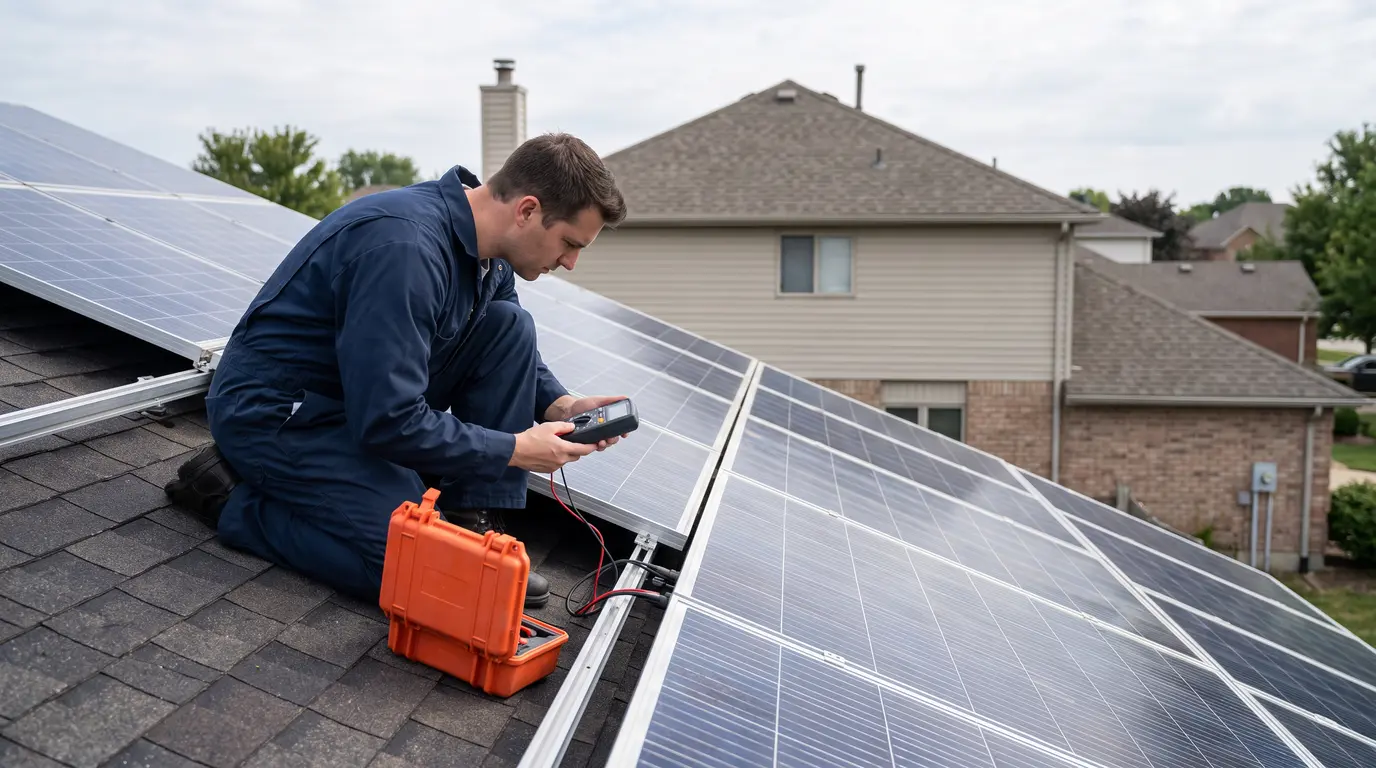
A cleaning and inspection visit is cited at approximately $300 to $700 for a specified small residential system, with an average near $400 in the cited estimate. That figure is not a universal annual price. System size, home height, labor, materials, and the inspection scope can all change the quote.
Before scheduling service, compare a cleaning only quote with a cleaning and inspection quote. Ask what the inspection actually reviews, such as monitoring data, visible wiring, racking, roof penetrations, inverter status, and other accessible components. A useful question is: What exactly is included in this maintenance price, and what will be billed separately if the technician finds a fault?
Monitoring
Monitoring can help identify unusual production, faults, and system interruptions. Many residential inverters, microinverters, and optimizers include monitoring capabilities, although some systems may involve additional costs for metering, internet connectivity, or subscription features. The U.S. Department of Energy monitoring guidance explains the role of these platforms without establishing one universal residential price.
A monitoring alert tells you that something deserves attention, but it does not identify the cause or the repair cost by itself. Shading, weather, communications problems, inverter faults, equipment failure, or a utility interruption can produce different symptoms. Ask whether monitoring remains included after the installer warranty or service agreement ends and who receives alerts at that point.
Service Plans and Less Frequent Repairs
Solar maintenance plans may bundle cleaning, electrical checks, inspections, and pest control measures. Consumer guidance describes these plans as typically costing a few hundred dollars per year, but contracts differ substantially. Review the visit frequency, response terms, exclusions, deductibles, labor coverage, and coordination with equipment warranties before signing.
An annual plan may be convenient for a homeowner who wants scheduled service, but it is not automatically the best value for every system. Compare the plan price with the services you are likely to use. Confirm whether the plan covers diagnosis only or includes limited corrective work, and ask what happens when a problem falls under a panel, inverter, racking, workmanship, or production warranty.
The larger future cost may be inverter replacement. DOE homeowner guidance states that a residential system may need a new inverter after approximately 10 to 15 years, while panels are designed for much longer service. Actual timing and out of pocket cost depend on the inverter type, warranty coverage, labor, system compatibility, and whether the replacement is covered. Keep this possibility in a separate reserve instead of assuming a cleaning plan includes it.
How to Plan Your Solar Maintenance Budget
Start with the maintenance information supplied for your system. Record whether monitoring is included, which warranties remain active, and what service the installer or provider already covers. Then keep routine service planning separate from less frequent corrective work.
When requesting a quote, ask for the scope in writing. The quote should make clear whether it includes roof access, cleaning materials, monitoring review, visible equipment checks, diagnosis, and follow up work. Also ask which party handles labor, shipping, and warranty claims if a covered component fails.
Maintenance is one part of the broader cost of owning a residential solar system. If you are evaluating total project ownership cost, the solar cost calculator can provide a preliminary estimate for a broader residential or commercial solar project. It does not establish separate prices for cleaning, inspections, monitoring subscriptions, repairs, or inverter replacement.
Frequently Asked Questions
Do solar panels need to be cleaned every year?
Not necessarily. Rain may provide enough natural cleaning for some tilted arrays. Dust, pollen, bird activity, nearby trees, and other buildup may justify professional cleaning, especially when production appears affected. Cleaning should reflect the conditions at your home rather than an automatic annual schedule.
Is solar panel monitoring free?
Monitoring is often included with the inverter or system platform, but some systems may have additional charges for internet connectivity, metering, or subscription features. Confirm what is included and how long access lasts with the equipment provider or installer.
How should homeowners budget for a future inverter replacement?
Treat inverter replacement as a separate future corrective expense rather than part of routine maintenance. DOE guidance indicates that replacement may be needed after approximately 10 to 15 years. Review the inverter warranty and keep a reserve because labor, compatibility, and warranty coverage can affect the amount you pay.
For most homeowners, the practical approach is simple: monitor production, clean only when site conditions justify it, compare the scope of inspection quotes, and keep a separate reserve for future equipment service. That approach keeps ongoing solar costs manageable without assuming that every system needs the same maintenance every year.