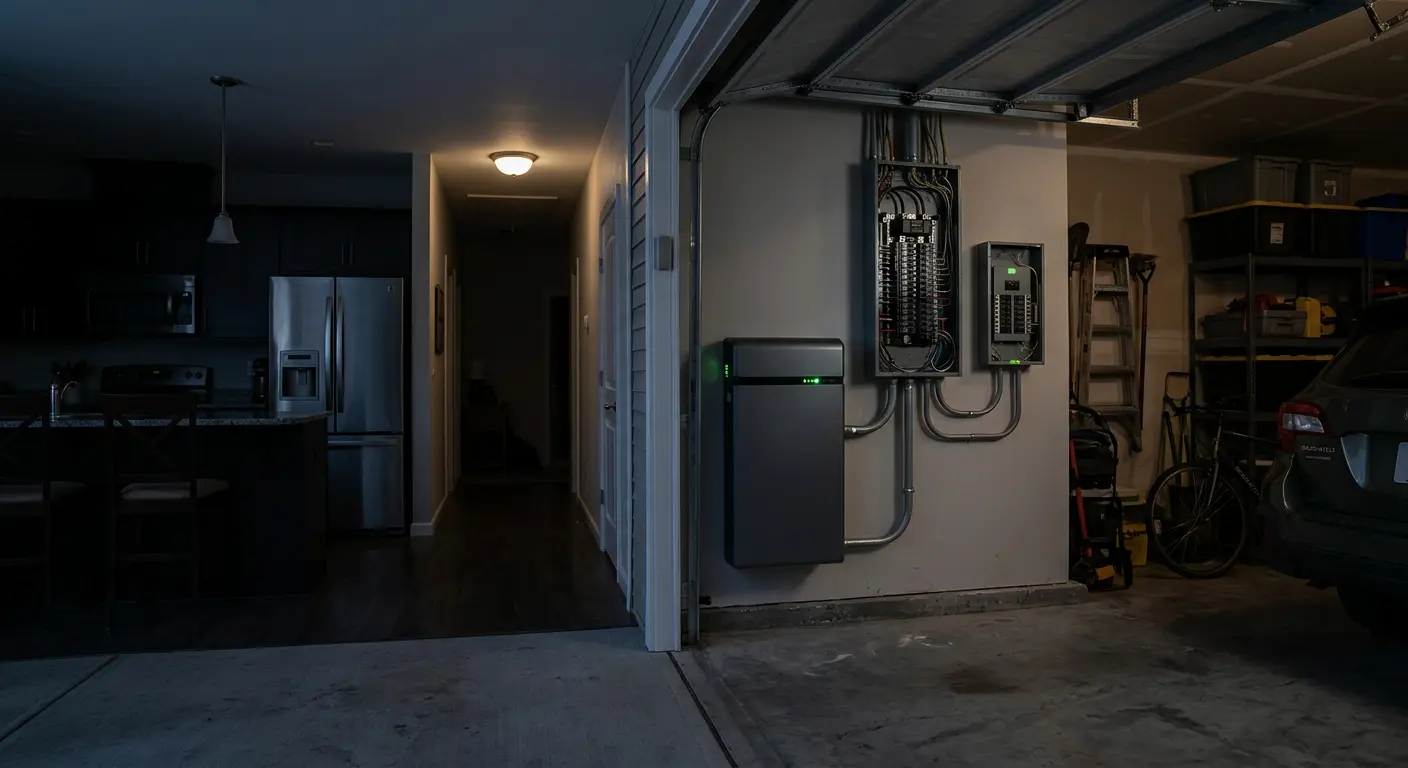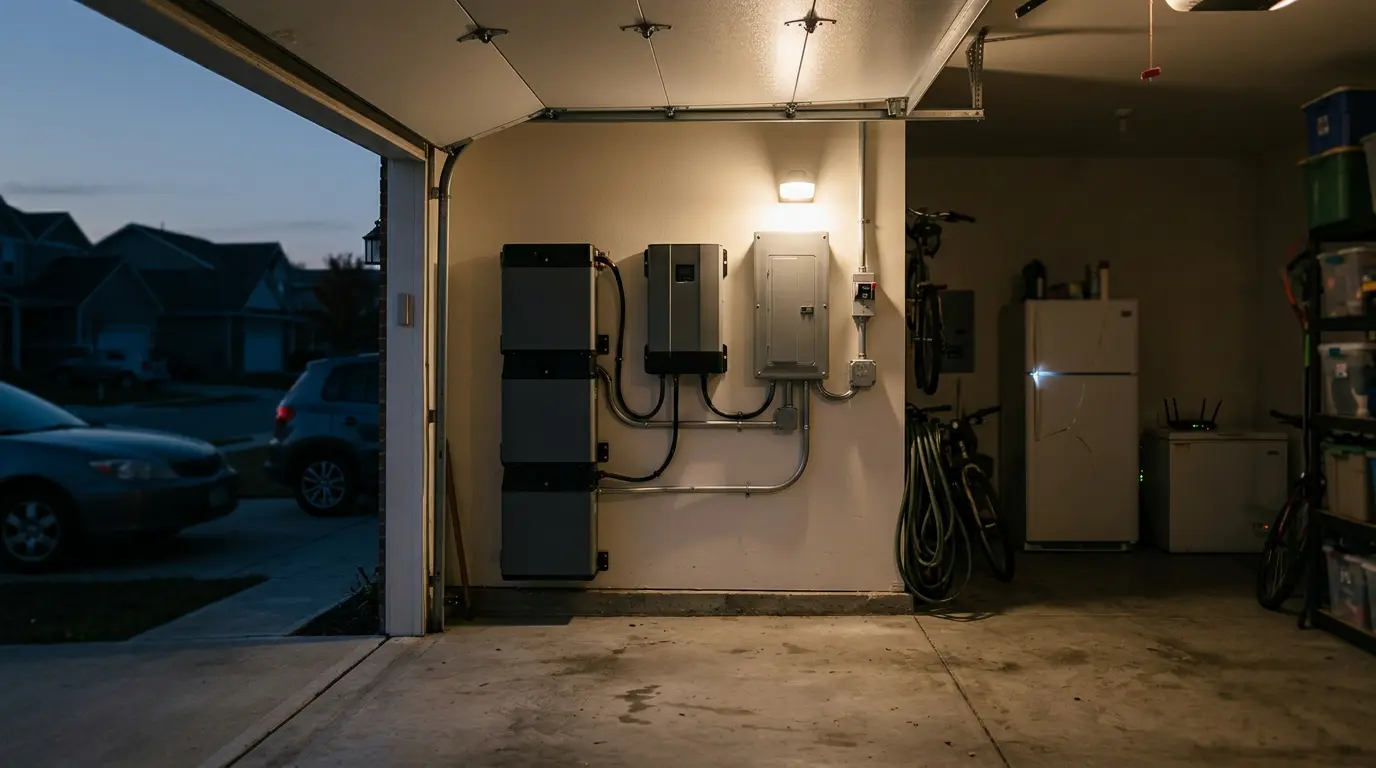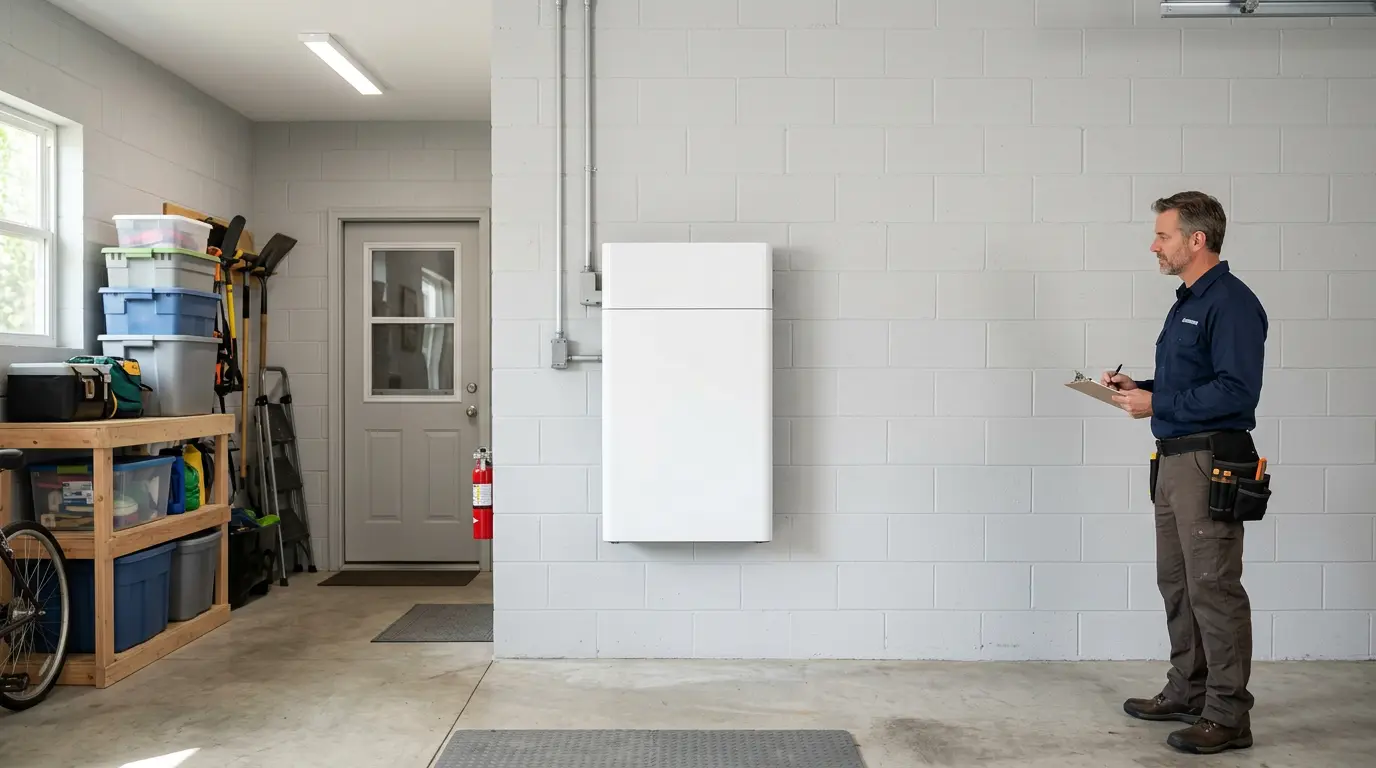
A home battery can often be installed outdoors, on an exterior wall, in a garage, or in a suitable nonhabitable utility, storage, or mechanical space. The acceptable location depends on the exact battery listing and installation manual, the system’s size, locally adopted building and fire codes, and the authority having jurisdiction, or AHJ.
That means there is no single location that is automatically right for every home battery. A sleeping room is not an acceptable location under the 2021 International Residential Code residential provisions, and a garage, basement, closet, or outdoor wall still has to meet product, safety, clearance, environmental, and local approval requirements.
The practical approach is to treat each possible location as a candidate, not a guarantee. Before installation, check the battery’s prohibited locations, required working space, protection from water and vehicle impact, fire safety measures, and the requirements enforced in your area.
Common Locations for a Home Battery
Under the 2021 IRC model code framework, possible residential energy storage system locations include utility closets, basements, storage or utility spaces, attached or detached garages, detached accessory structures, exterior walls, and outdoor ground locations. An energy storage system is often shortened to ESS.
These categories describe locations that may be addressed by the model code. They do not automatically approve every battery at every property. The locally adopted code, local amendments, the battery’s listing, the system capacity, site conditions, and the AHJ’s interpretation still control.
Sleeping rooms are not permitted locations under the 2021 IRC residential provisions. The same restriction applies to closets or other spaces that open directly into sleeping rooms. This is one reason an indoor battery is generally evaluated in a nonhabitable utility, storage, mechanical, or similar space rather than in a bedroom or living area.
A battery listed for indoor nonhabitable use may still have limits on mounting, airflow, clearances, water exposure, and service access. A battery listed for outdoor use may still be unsuitable for a particular exposed, flood prone, or inaccessible site. The listing helps define where the product may be used, but it does not override local code or site conditions.
For the model code language behind these categories, see the 2021 International Residential Code, Section R328. The IRC is a model code, not automatically binding law throughout the United States.
How Battery Size and Local Code Affect the Allowed Location
Battery capacity can change the compliance path. Under the 2021 IRC model code framework, an individual ESS unit is limited to 20 kWh. The same framework identifies aggregate limits of 40 kWh in utility closets, basements, and storage or utility spaces, and 80 kWh in attached or detached garages, detached accessory structures, on exterior walls, or outdoors on the ground.
Aggregate capacity means the combined rating of multiple ESS units, not just the capacity of one battery. A system with several units therefore needs to be evaluated as a system, rather than by looking only at each unit separately.
Systems that exceed the applicable model code limits are directed to provisions of the International Fire Code rather than the simplified residential framework described above. That does not mean a larger system is automatically impossible to install. It means the applicable review and compliance pathway may change.
These figures are specifically 2021 IRC model code thresholds. They are not universal nationwide limits. A state, county, city, tribal authority, or other AHJ may use a different code edition, amend the model language, or impose additional building, fire, electrical, zoning, flood, planning, or utility requirements.
Before choosing a location, ask the installer or building department which code editions and amendments apply, how the system capacity will be classified, and whether additional approvals are required.
Product Specific Clearances and Installation Restrictions
The exact battery model matters. ESS equipment must be installed according to the manufacturer’s instructions and listing, while the electrical installation must comply with NFPA 70 as adopted and enforced by the applicable jurisdiction. There is no single clearance measurement that applies to every home battery.
For example, the cited Tesla Powerwall 3 guidance specifies minimum clearances of 4 inches on each side, 2 inches above, and 0.8 inches below when the unit is wall mounted. It also specifies 12 inches in front for airflow and 36 inches in front for NEC 110.26 working space. Those measurements apply to that Powerwall 3 documentation, not to all residential batteries.
The same Tesla guidance says Powerwall is not intended for habitable or living spaces. It also addresses protection from flooding, nearby water sources, and vehicle impact paths. Those restrictions show why an available wall is not automatically an approved wall. The surrounding conditions matter just as much as the footprint of the equipment.
The Enphase IQ Battery 5P provides another product specific example. Its cited guide describes an indoor and outdoor NEMA Type 3R enclosure, manufacturer clearances, and protection from falling or moving objects, including motor vehicles. That information applies to the IQ Battery 5P and should not be treated as a universal rule for other products.
Compare the exact installation manual with every proposed location. Check the side, top, bottom, front, mounting, conduit, multiple unit, and service access requirements. The manual’s clearance diagram is more useful than a general instruction to “install it outside,” which is a little like saying a roof only needs to be “above the house.”
For product documentation, see Tesla’s Powerwall 3 clearance and site requirements and the Enphase IQ Battery 5P Quick Install Guide.
Safety Requirements for Indoor, Garage, and Outdoor Locations
Indoor and Basement Locations
An indoor battery should be evaluated for an appropriate nonhabitable area, such as a utility, storage, mechanical, or basement space. It should not be placed in a sleeping room or in a closet or space that opens directly into a sleeping room under the 2021 IRC residential provisions.
Indoor unfinished spaces may require additional protection for walls and ceilings under applicable fire safety guidance. NFPA’s residential ESS guidance also describes interconnected smoke alarms for homes with ESS and additional measures for unfinished rooms. The precise requirements depend on the adopted code, the equipment, the location, and the system.
A basement or utility area also needs to be checked for flooding, water entry, mounting conditions, ventilation requirements, working space, and maintenance access. The research does not establish one universal basement flood elevation, temperature requirement, or ventilation rule for every battery, so those details must come from the product documentation and local approval process.
Garage and Detached Structure Locations
Attached and detached garages, along with detached accessory structures, appear among the possible locations in the 2021 IRC model framework. A garage is not automatically the best, easiest, or code compliant choice, though. The battery must be evaluated for vehicle impact, clearances, detection, fire protection, mounting, and product restrictions.
The unit should not be placed in the vehicle driving path. Depending on the adopted standard, equipment, and site, an approved bollard or another impact barrier may be required. The applicable AHJ and the installation instructions determine what protection is needed.
NFPA’s discussion of residential ESS regulations addresses smoke alarms, protection in unfinished spaces, and impact protection where vehicles could strike the battery. This is professional guidance and does not by itself establish nationwide law. The local requirements still need to be confirmed.
Exterior Wall and Outdoor Locations
Exterior walls and outdoor ground locations may be practical options under the 2021 IRC model framework, subject to the applicable requirements. An outdoor listing does not mean the battery can be placed in any spot exposed to rain, runoff, standing water, heat, falling objects, or vehicle movement.
Review the proposed site for flooding, roof runoff, downspouts, nearby faucets or other water sources, snow accumulation, direct sun, excessive heat, weather exposure, and blocked service access. Also check the product’s requirements for mounting, airflow, working space, and protection from falling or moving objects.
The Tesla and Enphase materials provide product specific examples of these concerns. They do not establish one universal temperature limit, flood elevation, direct sun rule, or weather exposure rule for every home battery. Outdoor approval is still a site specific decision.
What to Confirm Before Choosing a Location
Use the following checklist to move from “there is room here” to “this location can be reviewed and approved.” The checklist does not replace the battery manual, installer, or AHJ. It helps make sure the right questions are asked before equipment arrives.
- Identify the exact battery model, enclosure rating, technology or chemistry, capacity in kWh, listing, and current installation manual.
- Ask the installer or AHJ which building, residential, fire, electrical, zoning, flood, and utility requirements apply at the property.
- Confirm which code editions are locally adopted and whether the jurisdiction has amendments or additional requirements.
- Compare every candidate location with the manufacturer’s prohibited location list and clearance diagram, including service access, mounting, conduit, and multiple unit clearances.
- For a garage, document that the battery is outside the vehicle driving path and determine whether an approved impact barrier is required.
- For an indoor location, confirm that it is nonhabitable, does not open directly into a sleeping room, and can accommodate any required wall, ceiling, smoke, heat, or other fire safety measures.
- Check for flooding, water sources, roof runoff, snow, direct sun, heat sources, combustible storage, blocked ventilation, and insufficient maintenance access.
- Obtain the required permit and retain the approved plans, equipment listing, installation manual, inspection record, and final location details.
Keeping those records can help with future service, emergency response, property records, and questions from an insurer. Permit and insurance consequences vary, so no particular placement should be assumed to cause a coverage denial automatically.
Common Misconceptions About Home Battery Placement
Misconception: A home battery can go anywhere there is enough physical room.
Correction: The product listing and instructions, required clearances, environmental exposure, fire and electrical rules, system capacity, and local approval requirements all affect the location.
Misconception: The 2021 IRC battery location rules automatically apply throughout the United States.
Correction: The IRC is a model code. It becomes enforceable through adoption by the relevant jurisdiction, often with amendments. A state, county, city, tribal authority, or other AHJ may use different requirements.
Misconception: A garage is always the easiest or safest battery location.
Correction: A garage may be a possible location, but vehicle impact, working clearances, detection, fire protection, mounting, and the product’s restrictions still need to be evaluated.
Misconception: An outdoor rated battery can be placed in direct weather or a flood prone spot without further review.
Correction: The outdoor listing does not remove the need to control flooding, water entry, damaging exposure, falling or moving objects, and inadequate service access.
Frequently Asked Questions
Can a home battery be installed inside the house?
It may be installed in an appropriate nonhabitable utility, storage, mechanical, or basement space if the product listing, manufacturer instructions, adopted codes, and local approval allow it. It should not be installed in a sleeping room or in a closet or space opening directly into a sleeping room under the 2021 IRC residential provisions.
Is a garage safe and code compliant for a solar battery?
A garage may be a possible location, but it is not automatically safe or code compliant. The battery must be outside the vehicle driving path and evaluated for impact protection, clearances, detection, fire protection, mounting, and the manufacturer’s restrictions.
Can a battery be installed in a basement or utility closet?
Those may be possible locations under the 2021 IRC model framework, subject to local adoption and additional requirements. Check for sleeping room access, flooding, water entry, required clearances, service access, and any fire protection or detection measures.
How far must a home battery be from doors, windows, property lines, or other equipment?
The supplied information does not establish one universal distance for every battery and property. Required clearances depend on the product manual, electrical working space, locally adopted code, site conditions, and AHJ review. The exact installation manual must be checked for the proposed location.
Can a home battery be installed outdoors in direct sun or rain?
Some batteries are listed for outdoor installation, but that does not approve every exposed site. Check the product guidance for flooding, water sources, weather exposure, direct sun, heat, mounting, airflow, falling objects, and service access.
What happens if the battery is larger than 20 kWh?
Under the 2021 IRC model framework, an individual ESS unit is limited to 20 kWh. A system above the applicable model code limits may be directed to International Fire Code provisions, which can change the compliance pathway. The local AHJ must confirm how the system will be reviewed.
Does a battery need smoke or heat detection?
NFPA residential ESS guidance describes interconnected smoke alarms and additional protection for some unfinished indoor spaces. The precise requirement depends on the adopted code, system, location, and equipment, so confirm it with the installer and AHJ.
What should homeowners ask the building department before installation?
Ask which building, residential, fire, electrical, zoning, flood, and utility requirements apply; which code editions and amendments are in effect; what capacity limits affect the project; and whether permits, plans, detection, fire protection, or vehicle impact protection are required for the proposed location.
The best home battery location is not simply the place with an empty wall or spare corner. It is a location that fits the specific product instructions, capacity limits, environmental conditions, safety measures, and locally adopted requirements. Confirm the site with the current battery manual, the installer, and the AHJ before installation, and keep the approved records for future reference.