Microinverters or a String Inverter: Which Fits Your Home?
Neither inverter type is best for every solar installation. Microinverters are generally a strong fit for roofs with partial shading, multiple orientations, or likely future expansion. A conventional string inverter can be attractive for a simpler, mostly unshaded roof where lower equipment cost and centralized servicing are priorities.
The key difference is where electricity is converted. A string inverter converts direct current electricity from a group of panels connected in a series string into alternating current for the home and grid. A microinverter performs that conversion at each individual panel.
That architectural difference affects how shading, panel failures, monitoring, maintenance, installation, and expansion are handled. The right choice depends less on which technology sounds newer and more on how your roof and long term plans fit the system.
How String Inverters and Microinverters Work
String inverter system
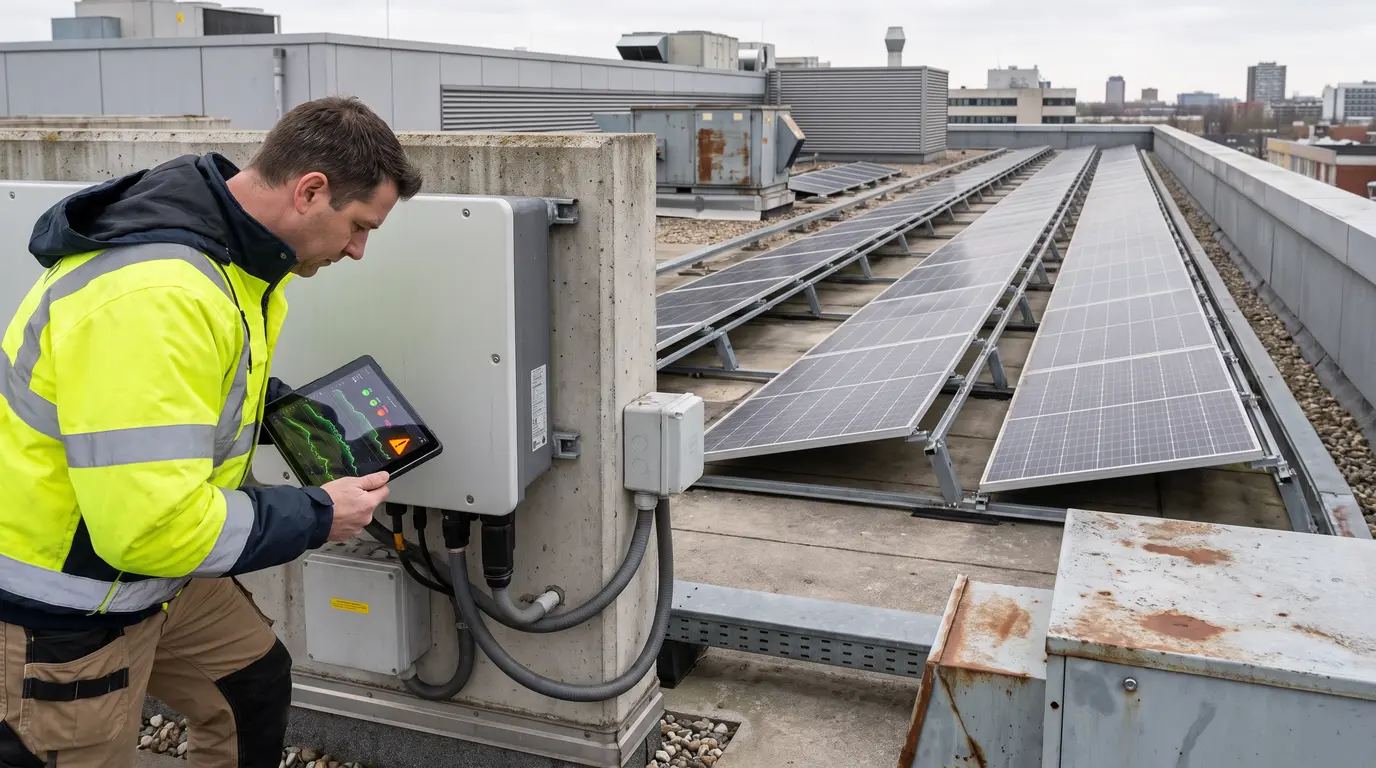
In a conventional string system, several solar panels are connected together in a series string. The string sends direct current electricity to one central inverter, usually installed in an accessible location. That inverter converts the electricity to alternating current used by the home and utility grid.
The panels in a string work as a group. If one panel is shaded, mismatched, or affected by a failure, production from the associated string can be reduced. That does not necessarily shut down the entire array, but it can affect more than the individual panel.
Microinverter system
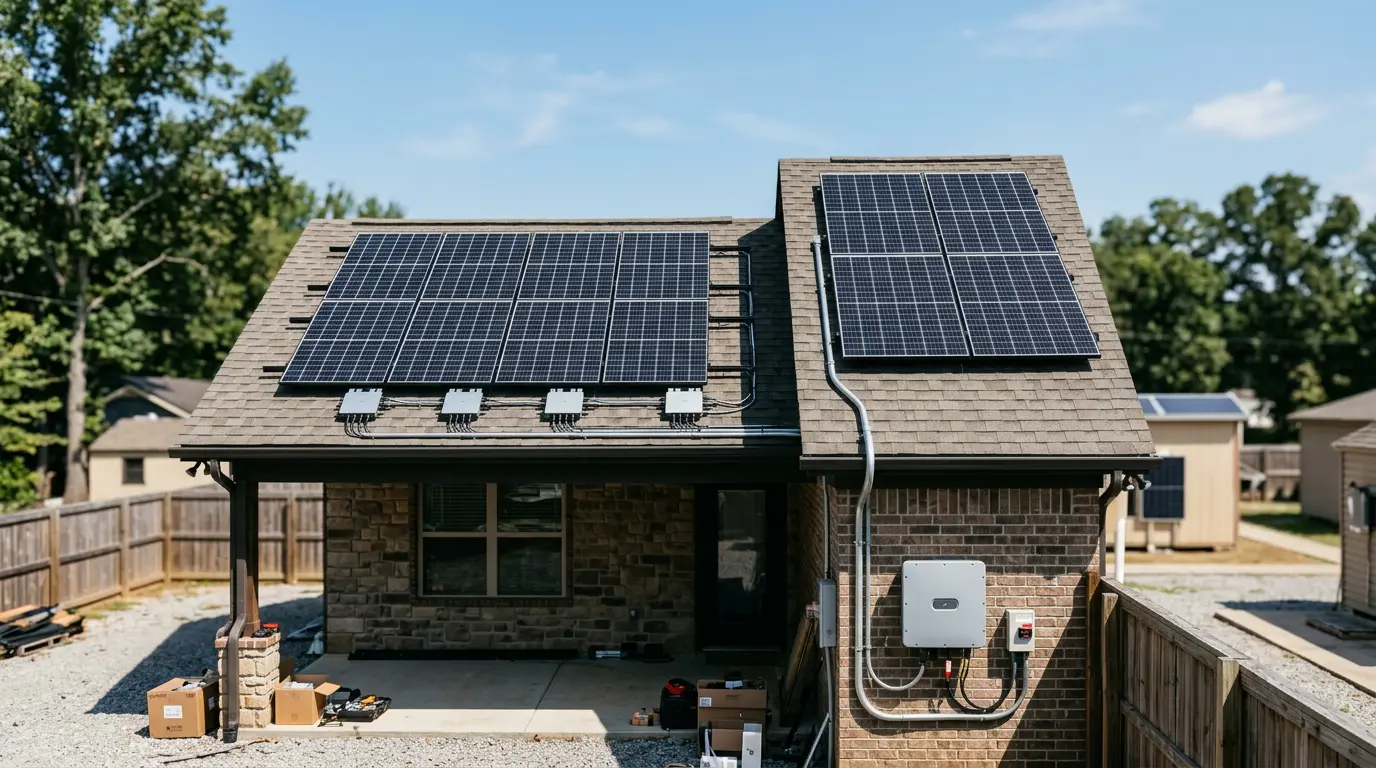
A microinverter is installed at each panel and converts that panel’s direct current output to alternating current at the panel level. The panels operate more independently instead of relying on one central inverter for the array.
If one panel is shaded or its microinverter stops working, the effect is generally limited to that panel. Other panels can continue operating independently. Microinverters do not restore sunlight blocked by a tree, chimney, or neighboring building, but they can reduce the electrical effect of one underperforming panel on the rest of the system.
Power optimizers are a separate configuration. They perform direct current to direct current conversion at the panel, while the system still uses a string inverter for the final conversion to alternating current.
Microinverters vs String Inverters Comparison
This table compares the two architectures on the factors that usually matter most to homeowners. Actual capabilities depend on the equipment package, system design, installer, utility, and local requirements.
| Factor | Microinverter system | Conventional string inverter system | Qualification |
|---|---|---|---|
| Panel interaction | Each panel has its own inverter and operates more independently. | Panels are grouped into strings connected to a shared inverter. | System design can include additional module level electronics. |
| Partial shading | Shading is generally localized to the affected panel. | Shading or mismatch can reduce output from the affected string. | Microinverters cannot replace sunlight blocked by physical shade. |
| Monitoring | Commonly supports panel level monitoring, depending on the product and communications equipment. | May primarily provide inverter or string level information unless module level equipment is added. | Monitoring features are product specific. |
| Expansion | Often modular because each added panel can receive its own inverter. | May require an inverter capacity, string design, compatibility, and electrical service review. | Utility approval, code, roof space, and equipment limits still apply. |
| Centralized servicing | There is no single central inverter for the array. Individual roof mounted units may need diagnosis or replacement. | One central inverter is typically easier to locate and service, but its failure can interrupt the connected array. | Labor, access, warranty, and service policies vary. |
| Relative equipment cost | Microinverter equipment was rated higher cost than conventional string inverter equipment in an NREL 2017 benchmark. | Conventional string inverter equipment was rated lower cost in that same historical benchmark. | The benchmark is not a current installed price estimate. |
The practical tradeoff is straightforward: microinverters distribute conversion equipment across the roof, while string systems concentrate much of it in one location. Distributed equipment can provide more independent panel operation. Centralized equipment can make servicing more direct. Neither arrangement removes the need for careful system design.
Performance Under Shade and Different Roof Conditions
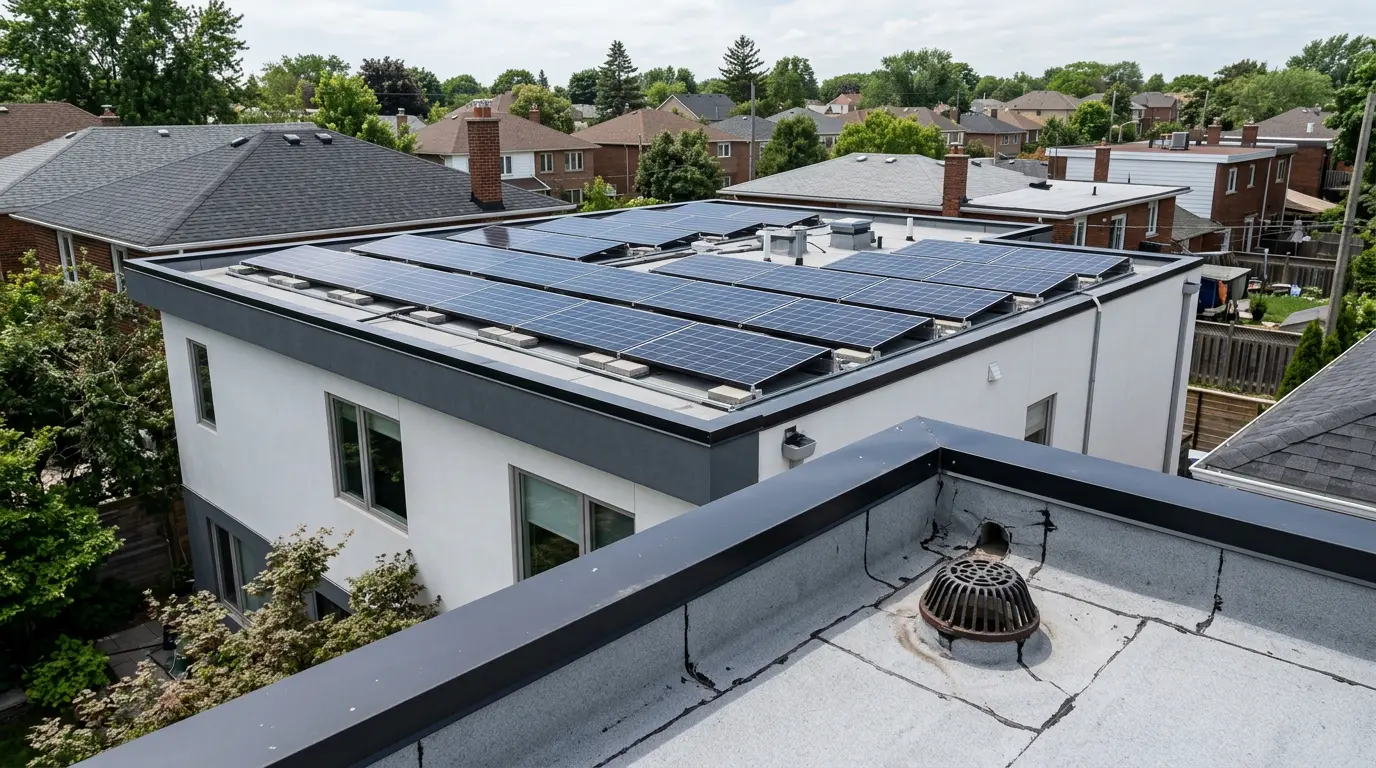
Microinverters are generally more appealing when panels will face different shading conditions or sit on multiple roof planes with different orientations. Each panel can operate more independently, which can reduce the effect of mismatch between panels.
Testing by the National Renewable Energy Laboratory compared specific 8 kilowatt systems under modeled shading conditions. In that testing, the microinverter system produced approximately 3.7 percent more energy under light shading, 7.8 percent more under moderate shading, and 12.3 percent more under heavy shading than the tested string inverter system.
Those figures are not universal performance guarantees. They apply to the equipment and conditions tested. Heavy shade can reduce production with either architecture because shaded panels receive less sunlight. Microinverters mainly limit how much an affected panel influences other panels.
A string system is not automatically unsuitable for a complicated roof. Multiple strings, separate maximum power point tracking inputs, or module level electronics can change the comparison. The proposal should show how the installer plans to handle each roof plane, shade pattern, and string design rather than treating every string system as identical.
Ask for a shade and production analysis by roof plane. The analysis should account for recurring shade, different orientations, panel mismatch, and anticipated tree growth where those conditions apply.
Monitoring and Troubleshooting
Microinverter systems commonly support panel level monitoring, allowing the homeowner or installer to identify how individual panels are performing. A basic string inverter system may primarily report inverter level or string level information unless additional monitoring equipment or module level electronics are included.
Panel level data can make it easier to identify an underperforming panel, but monitoring is not the same as performance optimization. An app may show detailed data without guaranteeing higher production. Communications equipment, alerts, data retention, and support for the monitoring platform vary by product and package.
- Ask whether the system reports panel level, string level, inverter level, or whole home production.
- Confirm what communications equipment is included.
- Ask whether alerts are included and who supports the monitoring platform after installation.
- Request the monitoring details in the written proposal.
For broader background on inverter architecture, the U.S. Department of Energy’s inverter guidance explains how string and panel level systems differ.
Reliability, Service, and Warranties
Reliability should be judged by both the effect of a failure and the practical conditions for service. A failed microinverter may affect one panel, while a failed central string inverter can interrupt the output of the connected array.
Microinverters also place more electronic devices on the roof. Diagnosing or replacing one may require roof access and, depending on the installation, panel removal. A string inverter concentrates the equipment in one accessible location, but a failure of that central unit can affect the connected array while service is pending.
Do not assume that one architecture always lasts longer. Review the exact product warranty, failure support, availability of replacement equipment, labor coverage, roof access requirements, and installer service policy. A warranty term is not the same as an expected service life or a guarantee that every replacement cost will be covered.
Ask these questions before signing:
- Does the warranty cover labor as well as equipment?
- Are roof access, shipping, or other service costs excluded?
- What is the process for replacing a failed roof mounted microinverter?
- How will a string inverter be replaced if the original model is no longer available?
- Who handles the service request, and what response time does the installer provide?
Installation, Expansion, and Battery Planning
String systems usually place the inverter hardware in one location and may have a lower equipment cost. Microinverter systems place more electronics on the roof and may increase equipment and installation complexity. Compare the complete proposal rather than judging the system by the inverter line alone.
Future expansion is generally more modular with microinverters because additional panels can be paired with additional microinverters. A string system may require checks for inverter capacity, string voltage, current, equipment compatibility, and electrical service capacity before panels are added.
Microinverters do not make expansion automatic. The installer must still verify available roof space, branch circuit limits, service capacity, utility interconnection rules, rapid shutdown requirements, and compatibility with the existing monitoring or battery system.
If storage is part of your plan, inverter architecture alone does not determine compatibility. Battery equipment, electrical capacity, permitting, and the exact inverter model all matter. For related planning questions, read about whether a solar battery makes sense for your home and adding a battery to existing solar.
When comparing proposals, include panels, inverter equipment, racking, wiring, monitoring hardware, labor, permits, batteries, warranties, and expected service costs. You can also estimate your solar project cost as an initial planning step, but a calculator does not replace an equipment specific proposal.
Rapid shutdown and local compliance
Rapid shutdown and electrical compliance depend on the locally adopted code, local amendments, authority having jurisdiction, utility requirements, and listed equipment. Neither microinverters nor string inverters should be treated as automatically exempt or automatically compliant.
Before signing, ask the contractor to identify the applicable electrical code edition, permit responsibility, rapid shutdown method, equipment listings, utility interconnection requirements, and any roof or fire access constraints. The UL Solutions explanation of model codes and listed equipment provides useful context, but local requirements control the project.
Which Inverter Should You Choose?
Microinverters are generally worth closer consideration when your roof has partial shading, several orientations, a complex layout, or a realistic possibility of adding panels later. Panel level monitoring may also be valuable if you want more detailed information about individual panel performance.
A string inverter may be attractive when the roof is relatively simple and mostly unshaded, the system can be designed with compatible strings, and centralized servicing or lower equipment cost is important. A well designed string system can be an appropriate choice even when the roof is not perfectly uniform.
Use the installer’s proposal to compare architectures on the same basis. Ask for the expected production by roof plane, the shade assumptions, the exact monitoring package, the expansion limits, the battery compatibility, and the complete warranty and service terms.
Common Misconceptions
Does one shaded panel shut down the whole system?
Not necessarily. In a conventional string system, shading can reduce production from the associated string. It does not automatically shut down the entire array. Microinverters generally isolate the panel level effect more effectively.
Do microinverters guarantee more production?
No. Their potential advantage depends on conditions such as shading, different roof orientations, and panel mismatch. A simple, mostly unshaded roof may provide less opportunity for that advantage.
Can string systems provide panel level monitoring?
Yes, depending on the complete equipment package. Additional module level electronics or monitoring hardware can provide more detailed information, although a basic string arrangement may provide less granular data.
Do microinverters make expansion automatic?
No. They can make expansion more modular, but roof space, electrical capacity, branch circuits, utility approval, code requirements, and equipment compatibility still apply.
Frequently Asked Questions
Which inverter type is better for a roof with partial shade?
Microinverters are generally more suitable because shading is more localized to the affected panel. They cannot restore the sunlight lost to shade, and a string system may also work when it is carefully designed with multiple strings or module level electronics.
Do microinverters produce more electricity on an unshaded roof?
Not automatically. Their benefit is more condition dependent, and a simple, mostly unshaded roof may provide less opportunity for the advantages associated with panel independence.
How does panel level monitoring differ from string level monitoring?
Panel level monitoring reports information for individual panels, while string level monitoring reports on a group of connected panels. Microinverters commonly support panel level monitoring, but exact features depend on the product and communications equipment. String systems may provide more detailed monitoring when additional module level equipment is included.
Are microinverters easier to repair or replace?
Not necessarily. A failed microinverter may affect only one panel, but it is installed on the roof and may require roof access or panel removal for service. A central string inverter is typically easier to locate and service, although its failure can interrupt the connected array.
Can I add panels later to a string inverter system?
Possibly, but the installer must check inverter capacity, string voltage and current, equipment compatibility, electrical service capacity, roof space, utility approval, and applicable code requirements.
Which inverter type works better with a home battery?
Neither architecture automatically answers that question. Battery compatibility depends on the exact inverter and battery equipment, system configuration, electrical capacity, permitting, and utility requirements. Review the proposed equipment together rather than choosing based on inverter type alone.
Do microinverters eliminate high voltage direct current wiring?
Microinverters convert panel output to alternating current at the panel level, while string systems send direct current from panel strings to a central inverter. The exact wiring arrangement, voltage, rapid shutdown method, and compliance requirements depend on the listed equipment and local project requirements.
What should a solar proposal say about inverter warranties and service labor?
It should identify the exact equipment model, warranty terms, exclusions, labor coverage, roof access responsibilities, replacement process, shipping coverage, and installer service policy. A warranty duration by itself does not establish the expected life or total replacement cost.
The Practical Choice
Choose the architecture that matches the roof, not the sales pitch. Microinverters generally offer more independent panel operation and flexible expansion, while string inverters can provide a simpler centralized design and lower equipment cost in suitable conditions.
Before committing, compare shade modeling, roof plane production, monitoring, service access, warranties, battery plans, expansion limits, and local compliance requirements. The best decision is the one supported by a complete equipment specific proposal that explains what the system can do and where its limits are.