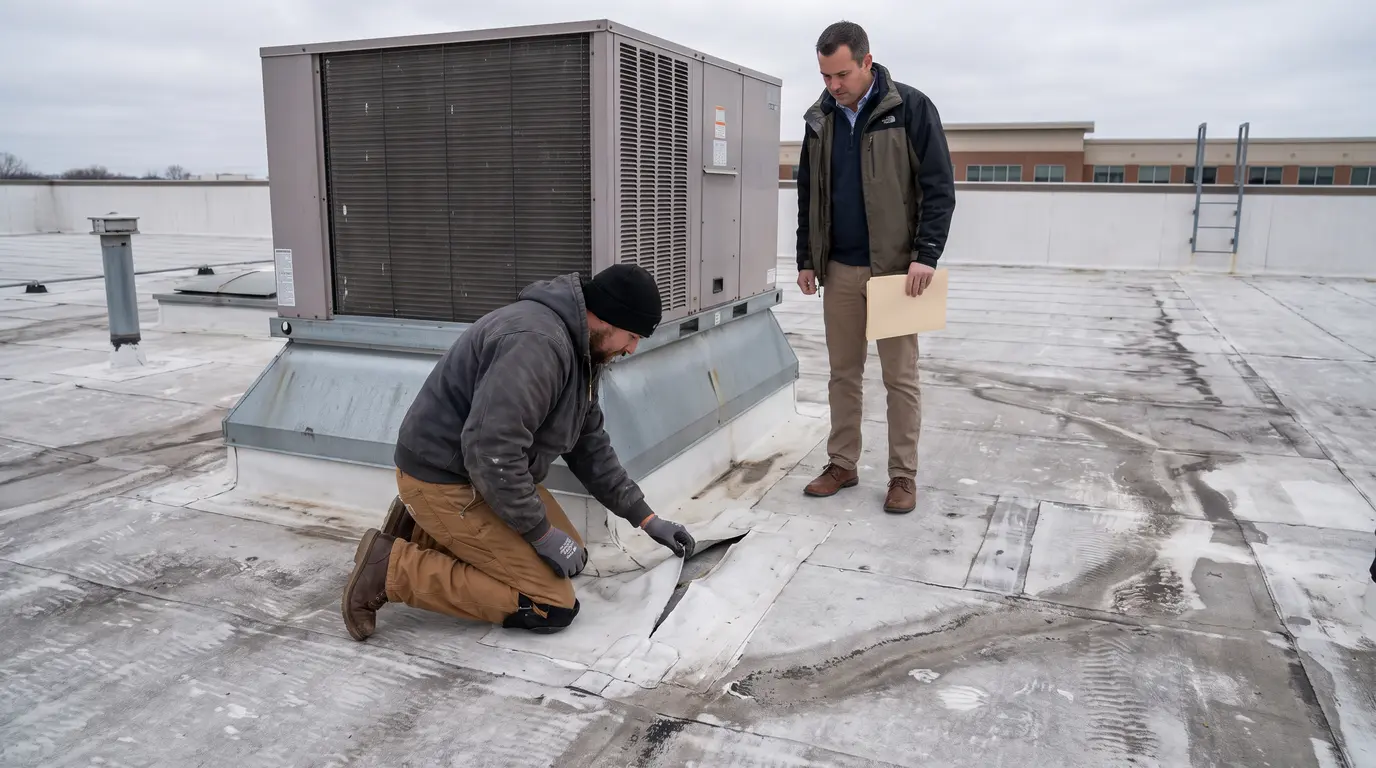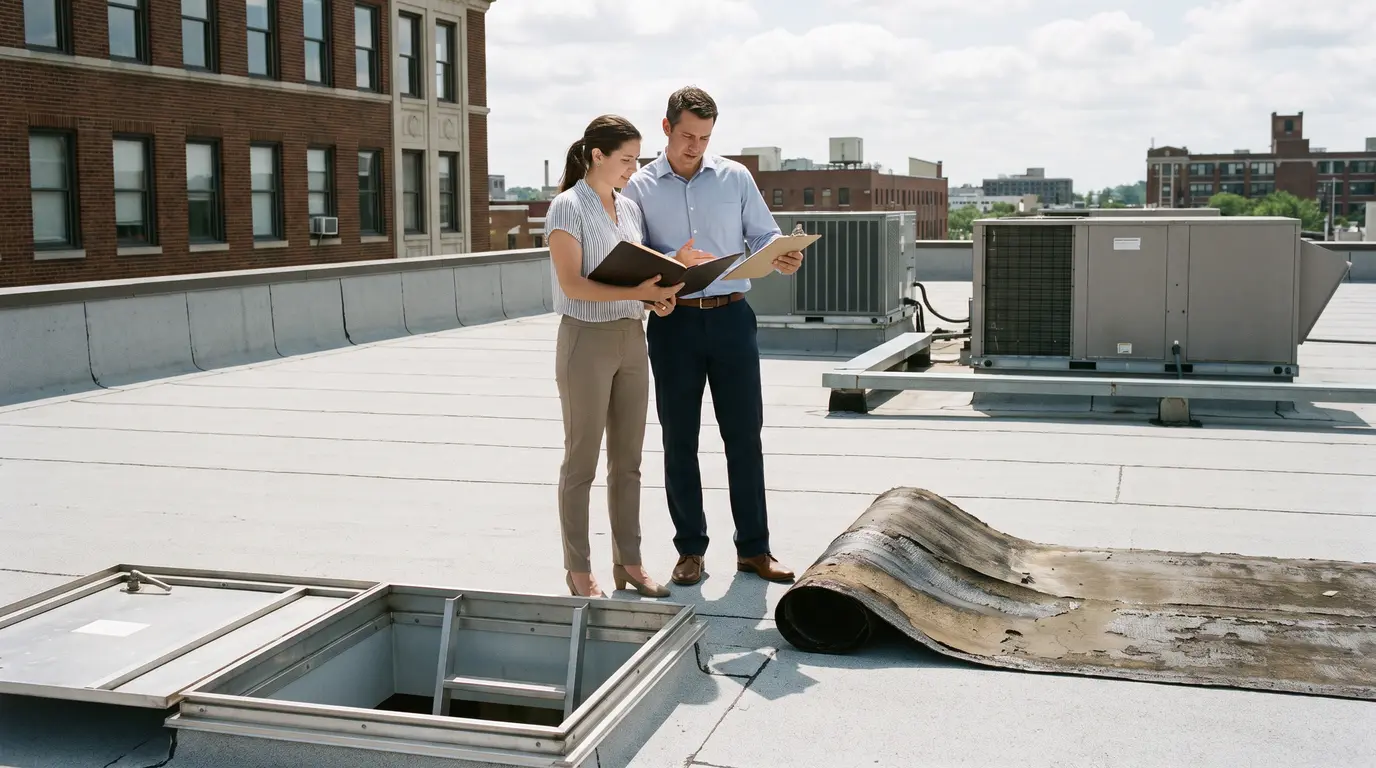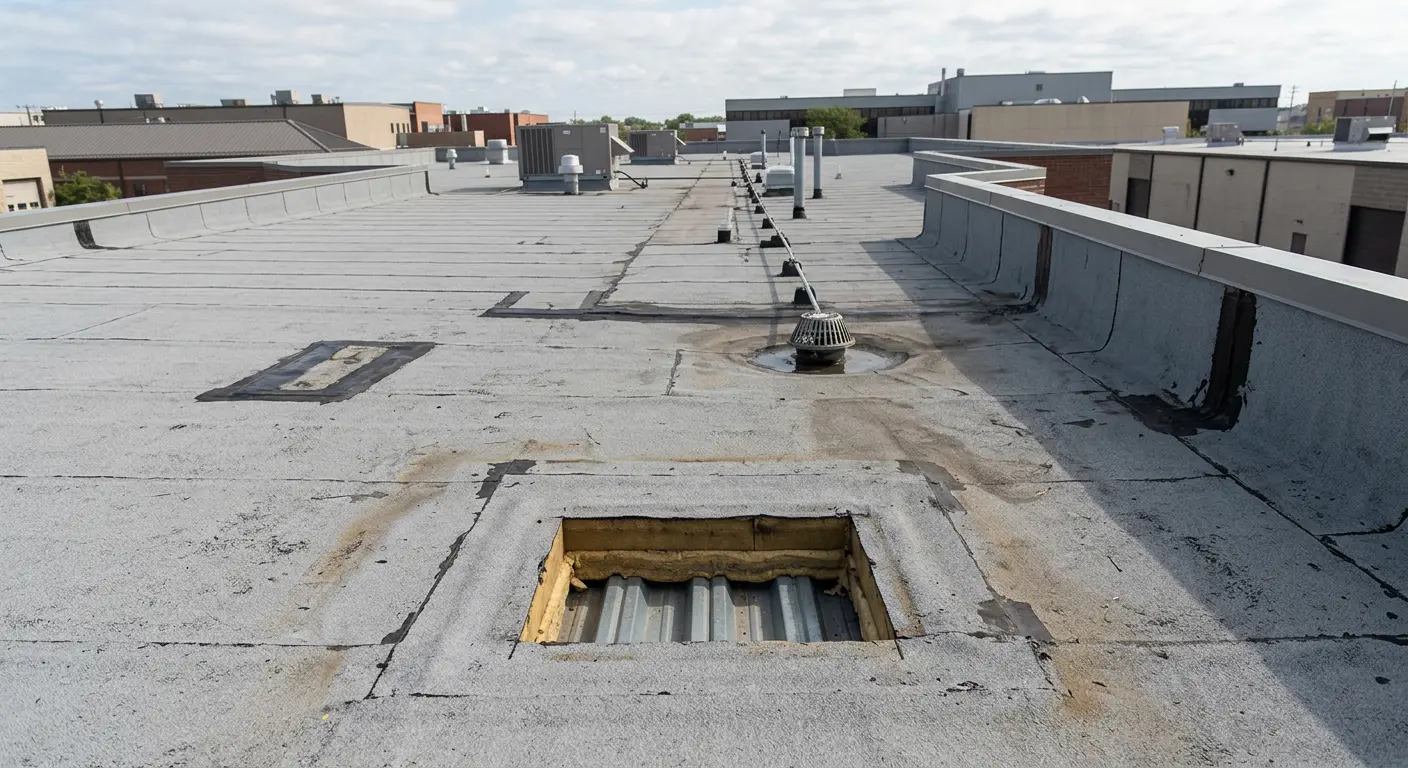
A commercial roof may be a good candidate for recovery when the existing assembly is structurally sound, dry, compatible with the proposed system, and supported by adequate drainage. Full replacement is generally the stronger choice when wet insulation, significant deterioration, unresolved drainage problems, excessive existing layers, or attachment limitations make it risky to leave the current roof in place.
The decision should follow a documented evaluation of the roof assembly, moisture conditions, drainage, code requirements, warranty requirements, and building operations. Roof age matters, but it should not be the only deciding factor.
What Commercial Roof Recovery and Replacement Mean
A roof recover installs a new roofing system over an existing roof instead of removing all existing materials down to the structural deck. When the existing assembly is eligible, recovery may reduce demolition, disposal, project duration, and disruption to building operations.
Recovery does not eliminate the need to investigate the roof below. Concealed moisture, deteriorated materials, drainage defects, or incompatible attachment conditions can remain beneath the new system. The proposed assembly must work with the existing roof and meet applicable code and manufacturer requirements.
Full replacement removes enough of the existing roof to expose and evaluate the underlying assembly more directly. It can provide an opportunity to address wet insulation, deck damage, insulation improvements, flashing, perimeter details, and drainage. It also generally involves more demolition, disposal, cost, and potential disruption.
Recovery Versus Replacement at a Glance
| Decision factor | Recovery may fit when | Full replacement becomes more appropriate when |
|---|---|---|
| Existing assembly | One eligible, structurally sound roof assembly remains in place. | Multiple layers or a deteriorated base limit recovery. |
| Moisture | Testing indicates the relevant roof materials are dry, or affected areas can be removed and corrected. | Wet or water soaked insulation and other wet materials remain. |
| Drainage | Existing drainage performs acceptably or can be addressed within the recover design. | Persistent ponding or inadequate drainage requires broader correction. |
| Concealed conditions | The owner accepts leaving suitable existing materials in place after investigation. | The owner needs direct access to evaluate or repair the deck, insulation, flashing, or attachment conditions. |
| Operations | Reduced demolition and disruption are important, and the recover can be phased safely. | The project requires substantial assembly changes, or repeated repair risk is unacceptable. |
| Code and warranty | Local code and the selected manufacturer permit the proposed recover system. | Code, attachment, compatibility, or warranty requirements cannot be met without removal. |
These are screening conditions, not automatic approvals. A commercial roofing professional and the local authority having jurisdiction should confirm the actual assembly, applicable code requirements, and project scope.
Conditions to Check Before Choosing
Existing Layers and Roof Condition
Start with a documented assessment rather than the roof’s age alone. The evaluation should identify the existing roof type, number of layers, insulation condition, deck condition, drainage, flashings, penetrations, perimeter details, and repair history.
Under the 2024 International Building Code model provisions, recovery is not permitted in several situations, including when the existing roof or covering is water soaked or too deteriorated to serve as a base, when certain tile coverings are present, or when two or more roof coverings already exist. The 2024 IBC is a model code, not automatically the law at every property. The locally adopted code edition and amendments control, so the applicable requirements should be confirmed with the authority having jurisdiction. The 2024 International Building Code roof recover provisions provide a useful reference point for that discussion.
Moisture and Insulation
Moisture in insulation or other roof materials is one of the most significant recovery concerns. NRCA guidance does not recommend installing a recover system over wet insulation or other wet materials. Moisture testing can help locate areas that need removal before new roofing is installed, although the proper testing method and scope depend on the roof system and project.
A visual inspection alone may not identify concealed moisture. Ask the contractor to explain how moisture will be located, which areas are affected, and how wet materials will be removed or repaired. A new roof should not simply conceal known wet insulation or water soaked materials.
Drainage, Flashings, and Leak Sources
Drainage, slope, flashings, roof composition, historical repair records, leak sources, and ventilation all belong in the evaluation. Ponding water or inadequate drainage may make recovery unsuitable or require corrective work as part of a replacement project.
Recovery can still be workable when drainage performs acceptably or can be addressed in the proposed design. If recurring ponding points to a broader drainage defect, replacement may provide a more direct opportunity to correct the condition instead of placing another system over it.
Attachment, Compatibility, and Warranty
The proposed system must be compatible with the existing roof and attachment conditions. Confirm whether it can be attached through or over the existing assembly and whether the manufacturer will provide the requested warranty for that configuration.
If the existing materials prevent proper attachment or the selected manufacturer will not support the proposed assembly, removal may be necessary. This is a design and documentation question to resolve before approval, not an issue to discover after work begins.
When Recovery May Make Sense
Recovery may be attractive when one eligible roof assembly remains, the structure and base are sound, moisture testing supports leaving suitable materials in place, and a compatible recover system is available. It can also be a practical option when reducing demolition and operational disruption is a significant priority.
The building’s use and the current roofing material also influence the proposed approach. A system that works for one commercial roof may not be suitable for another, so the proposal should identify the existing assembly and explain why the new system is compatible.
If recovery remains under consideration, compare the available commercial roof material options in the context of the existing assembly. That resource can help frame the material discussion, but it does not establish one recommendation for every building or roof configuration.
When Full Replacement May Be the Stronger Choice
Full replacement becomes more compelling when the roof contains wet insulation, water soaked materials, significant deterioration, unresolved drainage problems, multiple existing layers, or conditions that prevent proper attachment and warranty support.
Removal also gives the owner a clearer opportunity to evaluate and address the deck, insulation, flashing, edge conditions, penetrations, and drainage. That broader access can be valuable when recurring leaks or concealed conditions make another covered over repair difficult to justify.
Replacement is not automatically the better choice for every building. It generally brings more demolition, disposal, cost, and disruption, and the actual scope depends on access, existing materials, roof details, the selected system, and concealed conditions.
Compare the Full Project Scope
A lower recovery price is not necessarily a lower total project cost if the proposals cover different work. Compare equivalent scopes and look for items such as drainage corrections, deck repairs, insulation upgrades, edge metal, flashing replacement, moisture testing, disposal, warranty requirements, and provisions for unexpected work.
Ask each contractor to describe what remains in place, what will be removed, how wet materials will be handled, and what happens if tear off reveals additional damage. The guide to compare roofing estimates can help organize questions about scopes, exclusions, warranties, disposal terms, and unexpected work. Its guidance is general, so adapt the comparison to the larger and more detailed scope of a commercial project.
For an initial budgeting conversation, the commercial roof cost calculator may provide a preliminary starting point. It should not be treated as a project specific price or as a substitute for verifying concealed conditions, specialized recover assemblies, allowances, or contractor proposals.
Plan for Code, Permits, and Building Operations
Code and permit questions should be addressed before selecting recovery or replacement. The applicable code edition may differ from the 2024 IBC model provisions, and local amendments, project details, and the authority having jurisdiction control the actual requirements.
Review commercial roof replacement permit requirements for general planning context, then confirm the requirements for this property and this proposed scope. That article addresses replacement permitting broadly and should not be treated as a jurisdiction specific determination for a recover.
Operational planning matters just as much as the roof assembly. The project plan should account for the building’s function, timeline, budget, weather, material availability, roof complexity, warranty requirements, and methods for minimizing disruption. Large or occupied buildings may require phasing and temporary weather protection.
- Identify which areas must remain operational during the work.
- Ask how work will be phased and protected from weather.
- Confirm how access, materials, disposal, and building occupants will be coordinated.
- Request a process for documenting and pricing concealed damage if removal is part of the project.
No universal schedule or phasing plan applies to every commercial building. The contractor’s proposed plan should reflect the property’s use, roof complexity, access, and operational priorities.
Questions to Ask Before Approval
Before approving a proposal, ask questions that connect the recommended method to evidence from the roof assessment:
- What specific evidence shows that the existing insulation, deck, drainage, and attachment substrate are suitable for recovery?
- If removal reveals additional wet materials or deck damage, how will the contractor document and price that work?
- What areas of the building must remain operational, and how will the work be phased and protected from weather?
- How many roof coverings are present, and which materials will remain in place?
- Will the proposed assembly meet local code and receive the requested manufacturer warranty?
Frequently Asked Questions
What is the difference between a commercial roof recover and replacement?
A recover installs a new roof system over an existing roof. Replacement removes existing roofing materials to provide more direct access to the underlying assembly. Recovery may reduce demolition and disruption, while replacement provides a better opportunity to address concealed moisture, deck damage, insulation, flashing, and drainage.
Can a commercial roof be recovered over wet insulation?
A recover should not simply be installed over wet insulation or other wet materials. Moisture testing can help locate affected areas, which may need to be removed and corrected before the new system is installed.
How does ponding water affect the recover decision?
Ponding water may indicate inadequate drainage or another condition that needs correction. Recovery may remain possible if drainage performs acceptably or can be addressed in the new design, but broader drainage problems may make replacement more appropriate.
Does a roof recover avoid all disruption and disposal costs?
No. Recovery can reduce demolition, disposal, project duration, and disruption when the assembly is eligible, but it still requires planning, installation access, material handling, and protection of building operations. The actual impact depends on the property and project design.
What should a commercial roofing proposal include before approval?
The proposal should explain the existing assembly, moisture findings, drainage conditions, proposed attachment method, materials that will remain or be removed, warranty support, code and permit considerations, operational phasing, disposal, and how unexpected concealed damage will be handled.
Making the Decision
Choose recovery when the existing roof is dry, structurally sound, compatible with the proposed system, within applicable layer limits, and supported by adequate drainage and warranty requirements. Choose full replacement when wet materials, deterioration, drainage defects, excessive layers, or attachment limitations make covering the existing roof a higher risk.
The most useful next step is a documented commercial roof assessment that evaluates the assembly, moisture, drainage, deck, flashings, code requirements, and building operations. Roof Mechanics is a roofing and solar directory that can help you find local contractors to include in that evaluation and proposal process, while the final method should be confirmed for the specific property and jurisdiction.